106
Sg
Seaborgium
Atomic Mass 269
Electron Configuration [Rn]7s25f146d4
Oxidation States 6, (5), (4), (3), 0 ​(parenthesized oxidation states are predictions)
Year Discovered 1974

Identifiers

Element Name Seaborgium
Element Symbol Sg
InChI InChI=1S/Sg
InChIKey VAOUCABZIBBBJH-UHFFFAOYSA-N

Properties

Atomic Weight

271

269

Relative Mass: 271.13393(63#)

Electron Configuration

[Rn]7s25f146d4

Atomic Radius

Empirical Atomic Radius : empirical: 132 pm (predicted)

Oxidation States

6, (5), (4), (3), 0 ​(parenthesized oxidation states are predictions)

Ground Level

Ionization Energy

7.8 ± 0.5 eV (The level was determined by interpolation or extrapolation of known experimental values or by semiempirical calculation; its absolutre accuracy is reflected in the number of significant figures assigned to it.)

Atomic Spectra

Levels Holdings

Physical Description

Solid

Element Classification

Metal

Element Period Number

7

Element Group Number

6

Estimated Crustal Abundance

Not Applicable

Estimated Oceanic Abundance

Not Applicable

History

Seaborgium was first produced by a team of scientists led by Albert Ghiorso working at the Lawrence Berkeley Laboratory in Berkeley, California, in 1974. They created seaborgium by bombarding atoms of californium-249 with ions of oxygen-18 using a machine called the Super-Heavy Ion Linear Accelerator. The collision produced atoms of seaborgium-263 and four free neutrons. Seaborgium-263 is an isotope of seaborgium with a half-life of about 1 second. Three months before the Berkeley group announced their discovery, a team of scientists working at the Joint Institute for Nuclear Research in Dubna, Russia, claimed to have produced seaborgium. Their method involved bombarding atoms of lead-207 and lead-208 with ions of chromium-54 with a device called a cyclotron. They believed that they had produced atoms of seaborgium-259. The Berkeley group's work was confirmed in 1993 and they were credited with the discovery. Seaborgium's most stable isotope, seaborgium-271, has a half-life of about 2.4 minutes. It decays into rutherfordium-267 through alpha decay or decays through spontaneous fission..

IIn June 1974, members of the Joint Institute for Nuclear Research in Dubna, U.S.S.R., reported their discovery of Element 106, which they reported to have synthesized. Glenn Seaborg was part of this group, and the element was named in his honor.

In September 1974, workers of the Lawrence Berkeley and Livermore Laboratories also claimed creation Element 106 "without any scientific doubt." The LBL and LLL Group used the Super HILAC to accelerate 18O ions onto a 249Cf target.

Element 106 was created by the reaction 249Cf(18O, 4N)263X, which decayed by alpha emission to rutherfordium, and then by alpha emission to nobelium, which in turn further decayed by alpha between daughter and granddaughter. The element so identified had alpha energies of 9.06 and 9.25 MeV with a half-life of 0.9 +/- 0.2 s.

At Dubna, 280-MeV ions of 54Cr from the 310-cm cyclotron were used to strike targets of 206Pb, 207Pb, and 208Pb, in separate runs. Foils exposed to a rotating target disc were used to detect spontaneous fission activities. The foils were etched and examined microscopically to detect the number of fission tracks and the half-life of the fission activity. Other experiments were made to aid in confirmation of the discovery.

Description

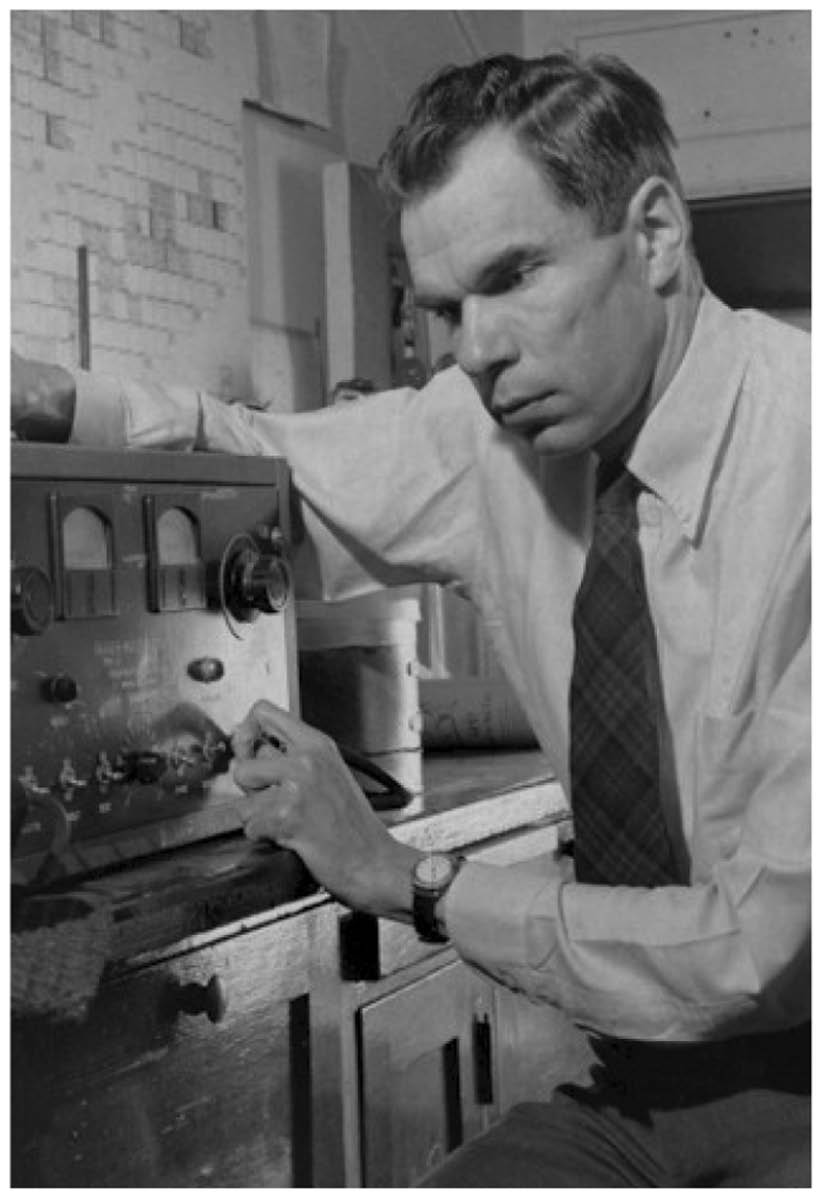
Seaborgium does not occur naturally in the Earth’s crust. In 1974, seaborgium was first synthesized by Albert Ghiorso and his team at the University of California in Berkeley using the nuclear reaction 249Cf (18O, 4n) 263Sg. The element is named for Glenn T. Seaborg (Fig. IUPAC.106.1), who synthesized a number of trans-uranium elements [634], [648].

Seaborgium has no commercial applications. However, 265Sg was one of the decay products used to confirm the synthesis of copernicium in a particle accelerator experiment.

Fig. IUPAC.106.1: Seaborgium is named after Glenn T. Seaborg who synthesized a number of trans-uranium elements. (Photo Source: © Lawrence Berkeley National Laboratory).

[634] Berkeley Lab-Lawrence Berkeley National Laboratory. The Search for “Heavy” Elements, Berkeley Lab-Lawrence Berkeley National Laboratory (2014), Feb. 25; http://www.lbl.gov/abc/wallchart/chapters/08/0.html.
[648] Los Alamos National Laboratory. Periodic Table of Elements: LANL-Seaborgium, Los Alamos National Laboratory (2014), Feb. 25; http://periodic.lanl.gov/106.shtml.

Seaborgium is named after Glenn Seaborg.

Users

Since only a few atoms of seaborgium have ever been made, there are currently no uses for seaborgium outside of basic scientific research.

Compounds

See more information at the Seaborgium compound page.

Element Forms

CID Name Formula SMILES Molecular Weight
56951717 seaborgium Sg [Sg] 269.128

Isotopes

Stable Isotope Count 0

Isotope Mass and Abundance

Isotope Atomic Mass (uncertainty) [u] Abundance (uncertainty)
271Sg 271.13393(63#)

Atomic Mass, Half Life, and Decay

Nuclide Atomic Mass and Uncertainty [u] Half Life and Uncertainty Discovery Year Decay Modes, Intensities and Uncertainties [%]
258Sg 258.113040 ± 0.000443 [Estimated] 2.7 ms ± 0.5 1997 SF≈100%; α ?
259Sg 259.114353 ± 0.000194 [Estimated] 402 ms ± 56 1985 α≈100%; SF ?; β+ ?
259Sgm 259.114353 ± 0.000194 [Estimated] 226 ms ± 27 2015 α≈97±0.1%; SF≈3±0.1%; β+ ?
260Sg 260.114383435 ± 0.000022045 4.95 ms ± 0.33 1984 SF=71±0.3%; α=29±0.3%
261Sg 261.115948135 ± 0.000019853 183 ms ± 5 1984 α=98.1±0.4%; β+=1.3±0.3%; SF=0.6±0.2%
261Sgm 261.115948135 ± 0.000019853 9.3 us ± 1.8 2010 IT=100%
262Sg 262.116338978 ± 0.000023797 10.3 ms ± 1.7 2001 SF=94±0.6%; α ?
262Sgp 262.116338978 ± 0.000023797 Not-specified
263Sg 263.118299 ± 0.000101 [Estimated] 940 ms ± 140 1974 α=87±0.8%; SF=13±0.8%
263Sgm 263.118299 ± 0.000101 [Estimated] 420 ms ± 100 1995 α≈100%; SF ?; IT ?
263Sgp 263.118299 ± 0.000101 [Estimated] Not-specified
264Sg 264.118930 ± 0.000304 [Estimated] 78 ms ± 25 2006 SF>80%; α ?
265Sg 265.121089 ± 0.000149 [Estimated] 9.2 s ± 1.6 1994 α>50%; SF ?
265Sgm 265.121089 ± 0.000149 [Estimated] 16.4 s ± 2.4 1994 α>50%; SF ?
266Sg 266.121973 ± 0.000263 [Estimated] 390 ms ± 110 2006 SF>90%
267Sg 267.124323 ± 0.000281 [Estimated] 1.8 m ± 0.7 2008 SF=83%; α=17%
268Sg 268.125389 ± 0.000504 [Estimated] 2 m [Estimated] α ?; SF ?
269Sg 269.128495 ± 0.000395 [Estimated] 5 m ± 2 2010 α≈100%; SF ?
270Sg 270.130362 ± 0.000492 [Estimated] 3 m [Estimated] α ?; SF ?
271Sg 271.133782 ± 0.000634 [Estimated] 2.2 m ± 1.1 2004 α=42±2.3%; SF=58±2.3%
272Sg 272.135825 ± 0.000743 [Estimated] 4 m [Estimated] α ?; SF ?
273Sg 273.139475 ± 0.000429 [Estimated] 5 m [Estimated] SF ?

Information Sources

  1. 1.  PubChem
  2. 2.  Atomic Mass Data Center (AMDC), International Atomic Energy Agency (IAEA)
  3. 3.  IUPAC Commission on Isotopic Abundances and Atomic Weights (CIAAW)
  4. 4.  IUPAC Periodic Table of the Elements and Isotopes (IPTEI)
    LICENSE
    Copyright (c) 2020 International Union of Pure and Applied Chemistry. The International Union of Pure and Applied Chemistry (IUPAC) contribution within Pubchem is provided under a CC-BY-NC-ND 4.0 license, unless otherwise stated.
    https://creativecommons.org/licenses/by-nc-nd/4.0/
  5. 5.  Los Alamos National Laboratory, U.S. Department of Energy
  6. 6.  Jefferson Lab, U.S. Department of Energy
    LICENSE
    Please see citation and linking information https https://www.jlab.org/privacy-and-security-notice
  7. 7.  NIST Physical Measurement Laboratory
  8. 8.  PubChem Elements
    Seaborgium

Shall we send you a message when we have discounts available?

Remind me later

Thank you! Please check your email inbox to confirm.

Oops! Notifications are disabled.