111
Rg
Roentgenium
Atomic Mass 282
Electron Configuration [Rn] 7s2 5f14 6d9(predicted)
Oxidation States 5, 3, 1, -1 ​(predicted)
Year Discovered 1994

Identifiers

Element Name Roentgenium
Element Symbol Rg
InChI InChI=1S/Rg
InChIKey LJROPTGWFUZRDB-UHFFFAOYSA-N

Properties

Atomic Weight

281

282

Relative Mass: 280.16514(61#)

Electron Configuration

[Rn] 7s2 5f14 6d9(predicted)

Atomic Radius

Empirical Atomic Radius : empirical: 138 pm (predicted)

Oxidation States

5, 3, 1, -1 ​(predicted)

Physical Description

Expected to be a Solid

Element Classification

Metal

Element Period Number

7

Element Group Number

11

Estimated Crustal Abundance

Not Applicable

Estimated Oceanic Abundance

Not Applicable

History

Roentgenium was first produced by Peter Armbruster, Gottfried Münzenber and their team working at the Gesellschaft für Schwerionenforschung in Darmstadt, Germany in late 1994. They bombarded atoms of bismuth-209 with ions of nickel-64 with a device known as a linear accelerator. This produced three atoms of roentgenium-272, an isotope with a half-life of about 1.5 milliseconds (0.0015 seconds), and a free neutron. Roentgenium's most stable isotope, roentgenium-281, has a half-life of about 26 seconds and decays through spontaneous fission.

Discovered by Gesellschaft Schwerionenforschung (GSI) in Darmstadt, in 1994. Reasearch group of S. Hofmann, V. Ninov, F.P. Hessberger, P. Armbruster, H. Folger, G. Munzenberg, H.J. Schott, and others.

Description

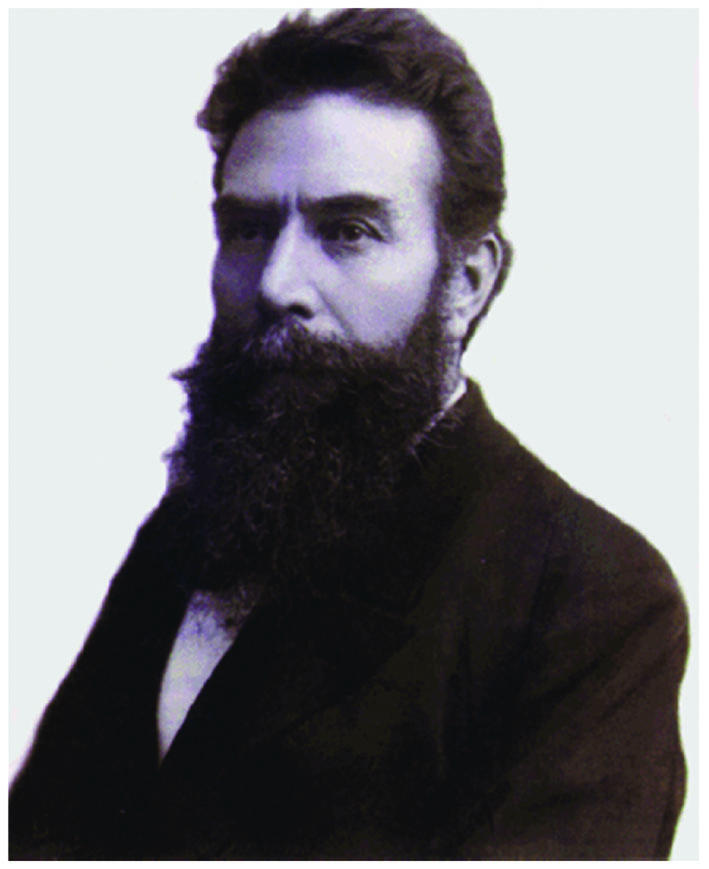
Roentgenium does not occur naturally in the Earth’s crust. Roentgenium was first synthesized by an international team of scientists from the GSI in Darmstadt, Germany, the Joint Institute for Nuclear Research (JINR) in Dubna, Russia, the Comenius University in Bratislava, Slovakia, and the University of Jyväskylä, Finland at the GSI Helmholtz Center for Heavy Ion Research in Darmstadt, Germany in 1994, using the nuclear reaction 209Bi (64Ni, n) 272Rg. The credit for the first synthesis was confirmed in 2003. The element was named after Wilhelm Conrad Roentgen (Fig. IUPAC.111.1), who discovered X-rays in 1895 [660], [661], [662]. Roentgenium has no known isotopic applications aside from scientific research.

Fig. IUPAC.111.1: Wilhelm Conrad Roentgen, discoverer of X-rays, after whom roentgenium was named. (Photo Source: NASA Goddard Space Flight Center).

[660] IUPAC Press Release. Element 111 is Named Roentgenium, International Union of Pure and Applied Chemistry (2017), August 28; http://old.iupac.org/news/archives/2004/naming111.html.
[661] Science Education at Jefferson Lab. It’s Elemental – The Element Roentgenium, Science Education at Jefferson Lab (2014), Feb. 25; http://education.jlab.org/itselemental/ele111.html.
[662] “CRC Handbook of Chemistry and Physics”, in CRC Handbook of Chemistry and Physics, W. M. Haynes (Ed.), Taylor & Francis Group, Milton Park, Didcot, UK (2014).

Roentgenium is named after Wilhelm Conrad Röntgen.

Users

Since only a few atoms of roentgenium have ever been produced, it currently has no uses outside of basic scientific research.

Compounds

See more information at the Roentgenium compound page.

Element Forms

CID Name Formula SMILES Molecular Weight
135476786 Rg * 282.169

Isotopes

Stable Isotope Count 0

Atomic Mass, Half Life, and Decay

Nuclide Atomic Mass and Uncertainty [u] Half Life and Uncertainty Discovery Year Decay Modes, Intensities and Uncertainties [%]
272Rg 272.153273 ± 0.000251 [Estimated] 4.2 ms ± 1.1 1995 α=100%
273Rg 273.153393 ± 0.000429 [Estimated] 2 ms [Estimated] α ?
274Rg 274.155247 ± 0.000225 [Estimated] 20 ms ± 11 2004 α≈100%
275Rg 275.156088 ± 0.000479 [Estimated] 5 ms [Estimated] α ?
276Rg 276.158226 ± 0.000675 [Estimated] 10 ms [Estimated] α ?; SF ?
277Rg 277.159322 ± 0.000504 [Estimated] 4 ms [Estimated] α ?; SF ?
278Rg 278.161590 ± 0.000417 [Estimated] 8 ms ± 5 2007 α=100%
279Rg 279.162880 ± 0.000453 [Estimated] 170 ms ± 110 2004 α=100%
280Rg 280.165204 ± 0.000571 [Estimated] 4.3 s ± 0.5 2004 α=100%
281Rg 281.166757 ± 0.000831 [Estimated] 19 s ± 5 2010 SF=87±0.8%; α=13±0.8%
282Rg 282.169343 ± 0.000631 [Estimated] 130 s ± 50 2010 α=100%
283Rg 283.171101 ± 0.000728 [Estimated] 2 m [Estimated] α ?; SF ?
284Rg 284.173882 ± 0.000537 [Estimated] 1 m [Estimated] α ?; SF ?
285Rg 285.175771 ± 0.000644 [Estimated] 30 s [Estimated] α ?; SF ?
286Rg 286.178756 ± 0.000492 [Estimated] 10 s [Estimated] 2016 α≈100%; SF ?

Information Sources

  1. 1.  PubChem
  2. 2.  Atomic Mass Data Center (AMDC), International Atomic Energy Agency (IAEA)
  3. 3.  IUPAC Commission on Isotopic Abundances and Atomic Weights (CIAAW)
  4. 4.  IUPAC Periodic Table of the Elements and Isotopes (IPTEI)
    LICENSE
    Copyright (c) 2020 International Union of Pure and Applied Chemistry. The International Union of Pure and Applied Chemistry (IUPAC) contribution within Pubchem is provided under a CC-BY-NC-ND 4.0 license, unless otherwise stated.
    https://creativecommons.org/licenses/by-nc-nd/4.0/
  5. 5.  Los Alamos National Laboratory, U.S. Department of Energy
  6. 6.  Jefferson Lab, U.S. Department of Energy
    LICENSE
    Please see citation and linking information https https://www.jlab.org/privacy-and-security-notice
  7. 7.  NIST Physical Measurement Laboratory
  8. 8.  PubChem Elements
    Roentgenium

Shall we send you a message when we have discounts available?

Remind me later

Thank you! Please check your email inbox to confirm.

Oops! Notifications are disabled.