101
Md
Mendelevium
Atomic Mass 258
Electron Configuration [Rn]7s25f13
Oxidation States 2F°7/2
Year Discovered 1955

Identifiers

Element Name Mendelevium
Element Symbol Md
InChI InChI=1S/Md
InChIKey MQVSLOYRCXQRPM-UHFFFAOYSA-N

Properties

Atomic Weight

258

258

Relative Mass: 258.0984315(50)

Electron Configuration

[Rn]7s25f13

Oxidation States

+3, +2

2, 3

Ground Level

27/2

Ionization Energy

6.58 eV

6.58 ± 0.07 eV (The level was determined by interpolation or extrapolation of known experimental values or by semiempirical calculation; its absolutre accuracy is reflected in the number of significant figures assigned to it.)

Electronegativity

Pauling Scale Electronegativity : 1.3(Pauling Scale)

Atomic Spectra

Levels Holdings

Physical Description

Solid

Element Classification

Metal

Element Period Number

7

Element Group Number

- Actinide

Melting Point

1100 K (827°C or 1521°F)

827°C

Estimated Crustal Abundance

Not Applicable

Estimated Oceanic Abundance

Not Applicable

History

Mendelevium was first produced by Stanley G. Thompson, Glenn T. Seaborg, Bernard G. Harvey, Gregory R. Choppin and Albert Ghiorso working at the University of California, Berkeley, in 1955. They bombarded atoms of einsteinium-253 with helium ions using a device known as a cyclotron. This produced atoms of mendelevium-256, an isotope with a half-life of about 77 minutes, and a free neutron. Mendelevium's most stable isotope, mendelevium-258, has a half-life of about 51.5 days. It decays into einsteinium-254 through alpha decay or decays through spontaneous fission.

Mendelevium is named after Dmitri Mendeleev. It is the ninth transuranium element of the actinide series discovered. It was first identified by Ghiorso, Harvey, Choppin, Thompson, and Seaborg in early in 1955 during the bombardment of the isotope 253Es with helium ions in the Berkeley 60-inch cyclotron. The isotope produced was 256Md, which has a half-life of 76 min. This first identification was notable in that 256Md was synthesized on a one-atom-at-a-time basis.

Description

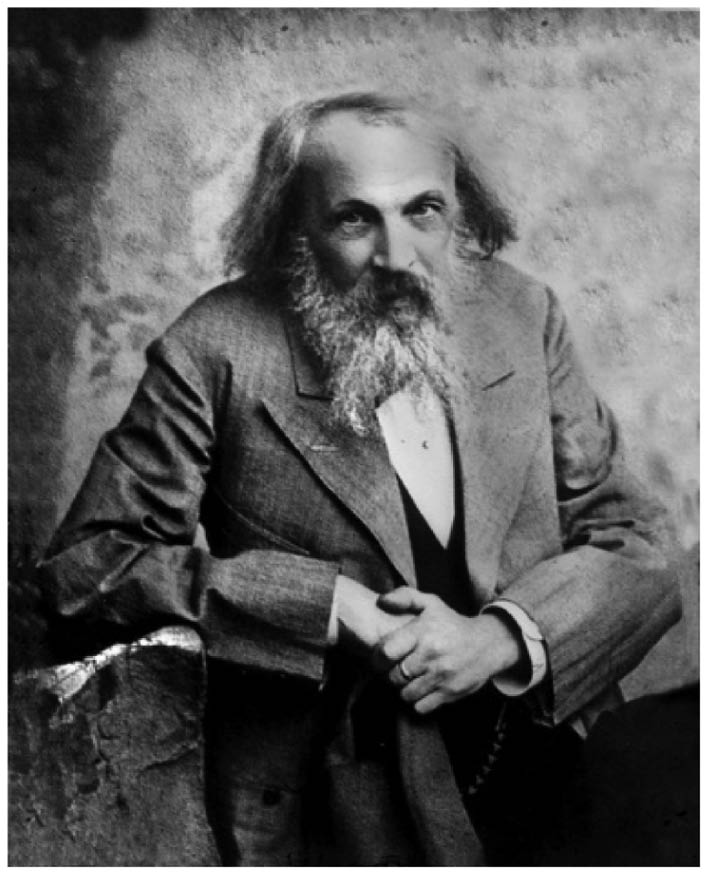
Mendelevium does not occur naturally in the Earth’s crust. It was first synthesized in 1955 by Glenn T. Seaborg and his team at the University of California using the reactions 253Es (4He, n) 256Md and 253Es (4He, 2n) 255Md. Mendelevium is named for the Russian scientist, Dmitri Mendeleev (Fig. IUPAC.101.1), who developed the Periodic Table of the chemical elements [636], [637]. There are no applications for isotopes of mendelevium aside from scientific research.

Fig. IUPAC.101.1: Mendelevium is named after Dmitri Mendeleev to honor his contributions to the development of the periodic table of the elements. (Photo Source: © 2010 The Regents of the University of California, Lawrence Berkeley National Laboratory).

[636] R. J. Silva. “Fermium, Mendelevium, Nobelium, and Lawrencium”, in The Chemistry of the Actinide and Transactinide Elements, L. R. Morss, N. M. Edelstein, J. Fuger (Eds.), Springer, Berlin, Germany (2006).
[637] Los Alamos National Laboratory. Periodic Table of Elements: LANL-Mendelevium, Los Alamos National Laboratory (2014), Feb. 25; http://periodic.lanl.gov/101.shtml.

Experiments seem to show that the element possesses a moderately stable dipositive (II) oxidation state in addition to the tripositive (III) oxidation state, which is characteristic of the actinide elements.

Users

Since only small amounts of mendelevium have ever been produced, it currently has no uses outside of basic scientific research.

256Md has been used to elucidate some of the chemical properties of mendelevium in aqueous solution.

Compounds

See more information at the Mendelevium compound page.

Element Forms

CID Name Formula SMILES Molecular Weight
23943 mendelevium Md [Md] 258.09843
169070 mendelevium-258 Md [258Md] 258.09843
167367 mendelevium-257 Md [257Md] 257.09554

Isotopes

Stable Isotope Count 0
Summary Fourteen isotopes are now recognized. 258Md has a half-life of 2 months. This isotope has been produced by the bombardment of an isotope of einsteinium with ions of helium. Eventually enough 258Md should be made to determine its physical properties.

Isotope Mass and Abundance

Isotope Atomic Mass (uncertainty) [u] Abundance (uncertainty)
258Md 258.0984315(50)
260Md 260.10365(34#)

Atomic Mass, Half Life, and Decay

Nuclide Atomic Mass and Uncertainty [u] Half Life and Uncertainty Discovery Year Decay Modes, Intensities and Uncertainties [%]
244Md 244.081157 ± 0.000402 [Estimated] 0.36 s ± 0.14 2020 α≈100%; β+ ?; β+SF<14%
244Mdm 244.081157 ± 0.000402 [Estimated] ~9 us 2020 IT=?; β+ ?
245Md 245.080864 ± 0.000279 [Estimated] 0.38 s ± 0.10 1996 α≈100%; β+ ?
245Mdm 245.080864 ± 0.000279 [Estimated] 0.90 ms ± 0.25 1996 SF≈100%; α ?
246Md 246.081713 ± 0.000279 [Estimated] 0.92 s ± 0.18 1996 α=100%
246Mdm 246.081713 ± 0.000279 [Estimated] 4.4 s ± 0.8 2010 α=57±0.3%; β+>77%; β+SF>10%; α<23%
247Md 247.081520 ± 0.000223 [Estimated] 1.19 s ± 0.09 1981 α≈100%; SF<0.1%
247Mdm 247.081520 ± 0.000223 [Estimated] 250 ms ± 40 1993 α=79±0.5%; SF=21±0.5%
248Md 248.082607 ± 0.000198 [Estimated] 7 s ± 3 1973 β+=80±1%; α=20±1%; β+SF<0.05%
249Md 249.082857155 ± 0.000176516 25.6 s ± 0.9 1973 α=75±0.5%; β+ ?
249Mdm 249.082857155 ± 0.000176516 1.9 s ± 0.9 2001 α=100%
250Md 250.084164934 ± 0.000097606 54 s ± 4 1973 β+=93.0±0.8%; α=7.0±0.8%; β+SF=0.026±1.5%
250Mdm 250.084164934 ± 0.000097606 42.4 s ± 4.5 2019 α= ?; β+ ?; IT ?
251Md 251.084774287 ± 0.00002031 4.21 m ± 0.23 1973 β+ ?; α=10±0.1%
251Mdp 251.084774287 ± 0.00002031 20 s [Estimated] 2006 α ?; IT ?
252Md 252.086385000 ± 0.000098 2.3 m ± 0.8 1973 β+≈100%; α ?
252Mdp 252.086385000 ± 0.000098 Not-specified
253Md 253.087143 ± 0.000034 [Estimated] 12 m ± 8 1992 β+≈100%; α≈0.7%
253Mdp 253.087143 ± 0.000034 [Estimated] 1 m [Estimated] 1971 α ?; IT ?
254Md 254.089590 ± 0.000107 [Estimated] 10 m ± 3 1970 β+≈100%; α ?
254Mdm 254.089590 ± 0.000107 [Estimated] 28 m ± 8 1970 β+≈100%; α ?
255Md 255.091081702 ± 0.000005976 27 m ± 2 1958 β+=93±0.1%; α=7±0.1%; SF ?
255Mdp 255.091081702 ± 0.000005976 2 m [Estimated] α ?; IT ?
256Md 256.093888 ± 0.000133 [Estimated] 77.7 m ± 1.8 1955 β+=90.8±0.7%; α=9.2±0.7%; SF<3%
256Mdm 256.093888 ± 0.000133 [Estimated] 100 m [Estimated] β+ ?; α ?; SF ?
256Mdp 256.093888 ± 0.000133 [Estimated] Not-specified
257Md 257.095537343 ± 0.000001683 5.52 h ± 0.05 1965 ε=85±0.3%; α=15±0.3%; SF ?
258Md 258.098433634 ± 0.000003729 51.59 d ± 0.29 1970 α≈100%; β+<0.0015%; β-<0.0015%
258Mdm 258.098433634 ± 0.000003729 57.0 m ± 0.9 1980 ε=85±1.5%; SF<15%; β- ?; α<1.2%
259Md 259.100445 ± 0.000108 [Estimated] 1.60 h ± 0.06 1982 SF≈100%; α ?
260Md 260.103650 ± 0.000339 [Estimated] 27.8 d ± 0.8 1989 SF≈100%; α<5%; ε<5%; β-<3.5%
261Md 261.105828 ± 0.000546 [Estimated] 40 m [Estimated] α ?
262Md 262.109144 ± 0.000481 [Estimated] 3 m [Estimated] SF ?; α ?

Information Sources

  1. 1.  PubChem
  2. 2.  Atomic Mass Data Center (AMDC), International Atomic Energy Agency (IAEA)
  3. 3.  IUPAC Commission on Isotopic Abundances and Atomic Weights (CIAAW)
  4. 4.  IUPAC Periodic Table of the Elements and Isotopes (IPTEI)
    LICENSE
    Copyright (c) 2020 International Union of Pure and Applied Chemistry. The International Union of Pure and Applied Chemistry (IUPAC) contribution within Pubchem is provided under a CC-BY-NC-ND 4.0 license, unless otherwise stated.
    https://creativecommons.org/licenses/by-nc-nd/4.0/
  5. 5.  Los Alamos National Laboratory, U.S. Department of Energy
  6. 6.  Jefferson Lab, U.S. Department of Energy
    LICENSE
    Please see citation and linking information https https://www.jlab.org/privacy-and-security-notice
  7. 7.  NIST Physical Measurement Laboratory
  8. 8.  PubChem Elements
    Mendelevium

Shall we send you a message when we have discounts available?

Remind me later

Thank you! Please check your email inbox to confirm.

Oops! Notifications are disabled.