
Synthesis Strategy of Pentafluorothio Group - Synthesis of Aliphatic Compounds Containing SF₅
Product Manager: Nick Wilde

The pentafluorosulfanyl (SF₅) group, as a unique fluorine-containing functional group, has demonstrated broad application prospects in medicinal chemistry, materials science, and other fields due to its excellent chemical stability, high electronegativity, and lipophilicity. In recent years, significant progress has been made in the research on synthetic methods for introducing the SF₅ group into aliphatic compounds. This article systematically reviews research achievements in areas such as using SF₅X as starting materials, reactions between SF₅Cl and diazo compounds, strain-release-driven pentafluorosulfanylation reactions, synthesis of SF₅-containing compounds through activation of SF₆, and the development of new pentafluorosulfanylation reagents.
1. Synthetic Strategies Using SF₅X as Starting Materials
In 2015, the teams of Duda and Lentz reported the synthesis and application of 3,3,3-trifluoromethyl-1-pentafluorosulfanylpropyne (11): At 80°C, SF₅Br converts the terminal CF₃-substituted alkyne 8 into the pentafluorosulfanyl olefin 9/10; at 90°C, the isomers 9/10 undergo a hydrogen bromide elimination reaction under the action of potassium hydroxide to yield 11. This compound can serve as an electron-deficient dienophile, reacting with various dienes 12 in dichloromethane (room temperature) or toluene (110°C) via the Diels-Alder reaction to generate pentafluorosulfanyl cycloalkenes 13.
In 2016, the teams of Thrasher and Haufe reported the synthesis of α-pentafluorosulfanyl-substituted carboxylic acid 17 and its derivative 18. Based on the method developed by the Dolbier research group in 2012, pentafluorosulfanyl-substituted acetic acid 15 was first prepared; subsequently, at room temperature in dichloromethane, using 4-dimethylaminopyridine (DMAP) and dicyclohexylcarbodiimide (DCC) as condensing agents, cinnamyl alcohol 14 was esterified with 15 to obtain pentafluorosulfanyl allyl ester 16; this intermediate was refluxed with triethylamine and trimethylsilyl trifluoromethanesulfonate in dichloromethane for 24 hours, undergoing an Ireland-Claisen rearrangement reaction to form 17, which could be further esterified with methanol to yield α-pentafluorosulfanyl ester 18.

In 2018, the Paquin research group reported the synthesis of 5-[(pentafluoro-λ⁶-sulfanyl)methyl]-2-oxazoline 21: First, SF₅Cl was added to N-allylamide 19 to prepare N-[2-chloro-3-(pentafluoro-λ⁶-sulfanyl)propyl]amide 20; subsequently, 1.1 equivalents of silver trifluoromethanesulfonate (AgOTf) were added to the toluene solution, and the mixture was heated at 110°C for 3 hours to obtain the target product 21. This reaction exhibits good tolerance to various substituents and functional groups, with excellent yields. In 2019, the same group employed a similar strategy to synthesize 5-[(pentafluoro-λ⁶-sulfanyl)methyl]-γ-butyrolactone 24: 4-enoic acid 22 was reacted with SF₅Cl in dichloromethane at -40°C under the catalysis of triethylborane for 2 hours, first converting it into pentafluorosulfanyl carboxylic acid 23; then, treatment with triethylamine/silver trifluoromethanesulfonate in toluene at 110°C ultimately yielded the SF₅-containing butyrolactone 24. The yield of this reaction decreases significantly in the absence of a base.

In 2019, the Paquin research group, based on the strategy of the Dolbier team in 2002, used triethylborane as a radical initiator to achieve the addition reaction of SF₅Cl to olefin 25 in n-hexane. Studies showed that at -40°C, the reaction of SF₅Cl with terminal olefin 25 could yield product 26 with a 100% yield, and the yield decreases with increasing temperature; when the amount of SF₅Cl is increased to 3 equivalents, the product can still be obtained quantitatively at room temperature. Solvent effect studies indicated that at -40°C, the reaction yields in various solvents ranged from 92% to 100%; at 0°C, the yield decreased to 52%-81% (acetonitrile was the best); at room temperature, the yield further decreased to 29%-66%. Additive experiments showed that at -40°C, basic additives such as triethylamine could only achieve a maximum yield of 26%, while phenol had no significant effect on the yield.
In 2019, the Paquin research group developed a new method for the gold-catalyzed synthesis of α-pentafluorosulfanyl ketone 30 using pentafluorosulfanyl terminal alkyne 29 as a starting material: The reaction was carried out using a (johnPhos)AuCl/AgOTf catalytic system in a mixed solvent of 1,4-dioxane and water at 70°C.

In 2020, the Paquin research group developed a new free radical activation method, using dicyclohexylamine borane (DICAB) as an initiator to realize the addition of SF₅Cl to alkenes. In methyl tert-butyl ether (MTBE) at -40°C, the DICAB catalyst forms a trialkylborane intermediate (35) with the alkene, and alkyl radicals are generated in the presence of trace oxygen; the radical reacts with SF₅Cl to generate SF₅ radicals, which then add to the alkene and couple with chlorine radicals to obtain the product (33). When triethylborane is used as the initiator and the reaction is carried out in n-hexane, the conversion of alkynes (31) can be achieved.
In 2021, the Paquin research group developed an SF₅Cl addition method based on a new activation pathway: 2,2-diphenylacetaldehyde (42) reacts with pyrrolidine (43) in dichloromethane or diethyl ether to generate 1-(2,2-diphenylethylidene)pyrrolidine (44); the electron donor-acceptor (EDA) complex (45) formed by this compound and SF₅Cl generates SF₅ radicals and intermediate (46) under light irradiation, and the latter spontaneously releases chlorine radicals and regenerates 1-(2,2-diphenylethylidene)pyrrolidine to complete the catalytic cycle; the generated SF₅ and Cl radicals then add to alkenes or alkynes to obtain the corresponding addition products (39) and (41).

In 2021, the Meyer research group used triethylborane as an efficient free radical initiator to successfully synthesize pentafluorosulfanyl-substituted cyclopropanes (48) through air-catalyzed initiation of the addition reaction between SF₅Cl and cyclopropene (47) in dichloromethane at -30°C to -40°C. The Cahard team extended this method to the reaction of vinylcyclopropane (50) with SF₅Cl.
In 2021, the Paquin research group reported a method for synthesizing N-(2-pentafluorosulfanylethyl)amine (55): using vinyl acetate (51) as the starting material, first reacting with SF₅Cl under the action of triethylborane, then reducing the acetate and C-Cl bond with lithium aluminum hydride to obtain SF₅-ethanol (52); then reacting with trifluoromethanesulfonic anhydride to generate trifluoromethanesulfonate (53); the intermediate reacts with secondary amines in dichloromethane in the presence of potassium carbonate to finally form the pentafluorosulfanyl-containing tertiary amine (55).

The Tlili research group developed a new method for synthesizing pentafluorosulfanylchloro-substituted alkenes (57) and alkynes (59). To address the volatility and toxicity of SF₅Cl, this method realizes in-situ generation through a dual-chamber reactor: in chamber 1 (C1), SF₅-TDAE-F (5) obtained by two-electron activation of SF₆ reacts with TCCA to generate SF₅Cl; then it is transferred to chamber 2 (C2) to react with alkynes (56) or alkenes (58). The reaction is carried out under mild conditions with moderate to excellent yields. It should be particularly noted that when alkynes (56) are used as substrates, the reaction can proceed without triethylborane.
In 2022, the Paquin research group reported the trans-hydrogen pentafluorosulfanylation reaction of terminal alkynes. The reaction is carried out in diethyl ether at -25°C, and SF₅ radicals are generated by 370 nm light excitation of SF₅Cl, which then react with terminal alkynes (60) to form vinyl radicals, and finally generate cis-pentafluorosulfanyl alkenes (61) through hydrogen atom transfer (HAT) of tris(trimethylsilyl)silane. Natural bond orbital (NBO) analysis shows that the hyperconjugation effect of the SF₅ group can stabilize the vinyl radical; density functional theory (DFT) calculations confirm that due to the lower energy barrier caused by the SF₅ group, the reaction preferentially forms cis products, explaining its stereoselectivity.
In 2022, the Qing research group developed a new method for directly synthesizing pentafluorosulfanyl-substituted phenylacetylenes (63): under blue LED irradiation, ethynylbenziodoxolone (62) reacts with SF₅Cl to efficiently prepare pentafluorosulfanylphenylacetylene derivatives.

In 2023, the Paquin research group reported the SF₅Cl addition reaction of alkenes (64) and alkynes (66) under photochemical conditions. Studies have shown that when irradiated with a 20W black light integrated fluorescent lamp (CFL), SF₅Cl can react with alkenes in toluene and alkynes in ethyl acetate at room temperature, respectively, to efficiently generate the corresponding addition products (65) and (67).
In 2023, the De Borggraeve team adopted the SF₅Cl preparation method developed by the Shibata research group and innovatively used an H-type reactor to realize the addition reaction of alkenes/alkynes: at -94°C, 1,2-bis(pyridin-4-yl)disulfane (3) reacts with trichloroisocyanuric acid and potassium fluoride in reaction chamber 1 (C1) for 6 hours to generate SF₅Cl; then the mixed solution of alkenes (68)/alkynes (69) dissolved in n-hexane or dichloromethane and triethylborane is injected into reaction chamber 2 (C2), and after SF₅Cl is transferred to C2, the reaction is carried out for 3 hours to obtain pentafluorosulfanyl-substituted alkanes (70) or alkenes (71).
In 2023, the Cahard and Bizet teams reported two important breakthroughs: first, the iodopentafluorosulfanylation reaction of alkynes (73) was realized, which requires 4 equivalents of potassium iodide as the iodine source and 1 equivalent of 18-crown-6 ether. Experiments and DFT calculation studies show that the reaction starts with the reaction of SF₅Cl with iodide anions to generate SF₅ anions and I₂, and the latter dissociates into iodine radicals under light; then SF₅ radicals are generated through two paths - either by the oxidation of SF₅ anions by I₃· radicals (generated by the reaction of iodine radicals with I₂) through single electron transfer (SET), or by the direct abstraction of halogen atoms from SF₅Cl by iodine radicals; the generated SF₅ radicals add to the alkyne to initiate a free radical chain reaction, and the regeneration of iodine radicals keeps the catalytic chain going. Another breakthrough of the team found that tetrahydrofuran plays a key role in the activation of SF₅Cl, and the chloropentafluorosulfanylation reaction of alkynes can be efficiently realized under additive-free conditions at -40°C, obtaining product (76) with excellent yield.
In 2023, the Paquin, Lam, and Mastalerz teams reported a method for preparing 2-pentafluorosulfanyl acetic acid (15) using SF₅Cl as a key intermediate, which then reacts with various carboxylic acids (77) through Kolbe electrolysis to generate pentafluorosulfanyl aliphatic compounds. The study adopted two electrolysis conditions: both using platinum electrodes (current density 67 mA/cm²), when sodium methoxide is used as the base, 0.17 M methanol and 22 F/mol charge are required; while when triethylamine is used as the base, only 0.06 M methanol and 12 F/mol charge are needed to complete the reaction.
In 2024, the team further synthesized 2-SF₅-substituted acetamides (79) using 2-pentafluorosulfanyl acetic acid (15) as a raw material and systematically compared their lipophilicity differences with other fluorine-containing groups. The specific method is as follows: 2-SF₅-substituted acetic acid (15) reacts with secondary amines in acetonitrile with 1.3 equivalents of 1-chlorobenzotriazole (NCBT) and triphenylphosphine at room temperature for 30 minutes, with 1 equivalent of triethylamine as the base, to directly obtain the target acetamide (79). After verifying the wide substrate applicability, the researchers determined that the log P value of compound (79a) is 0.65, while the log P value of the corresponding 2-CF₃-substituted acetamide is only 0.12, confirming that (79a) is the most lipophilic derivative in this series.
In 2023, the Paquin and Charette teams reported the intramolecular cyclopropanation reaction of pentafluorosulfanyl-substituted allyl cyano diazoacetate (83): in dichloromethane at room temperature, under the catalysis of Rh₂(esp)₂, the diazo compound (83) acts as a carbene precursor and undergoes cyclopropanation reaction with its own double bond. This method is also applicable to trifluoromethyl-substituted allyl cyano diazoacetate. It is worth noting that when 10 mol% Rh₂(S-nap)₄ catalyst is used, (83) reacts in dichloromethane at 30°C for 22 hours to obtain chiral pentafluorosulfanyl-substituted product (84a) with 8% yield and 66% enantiomeric excess (ee).

In 2024, inspired by the work of the Qing research group, Wang and Qin reported the copper-catalyzed chloropentafluorosulfanylation reaction of 1,3-enynes (85/87/89): in diethyl ether solvent, with Cu(MeCN)₄PF₆ as the catalyst and 6,6'-dimethyl-2,2'-bipyridine as the ligand, 1,3-enynes react with SF₅Cl. It is worth noting that when 1,3-enynes (85) with terminal alkene structure are used, SF₅-propargyl chloride (86) is obtained; 1,3-enynes (87) with terminal alkyne structure generate SF₅-1,3-dienes (88); in addition, when the 2-position substituent of 1,3-enynes with terminal alkene structure is larger than the 4-position, pentafluorosulfanyl-substituted allenes (90) are formed.
In 2024, the Paquin, Bouillon, and Ouellet-Du Berger teams reported the bromopentafluorosulfanylation reaction of terminal alkynes (91): in n-hexane solvent, terminal alkynes react with SF₅Cl, triethylborane, and 1.1 equivalents of carbon tetrabromide (bromine source) at room temperature for 3 hours to obtain β-bromopentafluorosulfanyl alkenes (92) with a yield of 24%-62%. It is worth noting that the amount of brominated products is significantly higher than that of chlorinated products, and the ratio of the two exceeds 2.3:1.
In 2024, the Tan, Zhou, and Wang teams reported the pentafluorosulfanylation reaction of acrylamide (93), successfully synthesizing SF₅-containing isoquinolinedione (94): in the presence of light and air, SF₅Cl first generates SF₅ radicals, which then react with alkenes to generate alkyl radicals; the radical attacks the aromatic ring, and finally constructs the isoquinolinedione skeleton (94) through single electron transfer and hydrogen elimination processes.
In 2024, the Blanchard, Meyer, and Bizet teams reported the reaction of terminal alkynamides (95) with 2 equivalents of SF₅Cl under three types of conditions: at -50°C, under triethylborane/oxygen catalysis, the reaction can be efficiently carried out in dichloromethane, dichloromethane/heptane mixed solvent, or n-hexane/toluene mixed solvent to obtain SF₅-substituted (E)-1-chloro-2-SF₅-enamine (96) with excellent yield.
In 2024, the Guo research group reported the photoinduced hydroxypentafluorosulfanylation reaction of alkenes (97/98): under 365 nm light irradiation, SF₅Cl undergoes free radical addition with α,β-unsaturated esters/amides (97) or styrenes (98) in dichloromethane, generating pentafluorosulfanyl alcohols (99) and (100) with 1 equivalent of water, 0.2 equivalent of 1-hexene, and oxygen as oxidants. The quantum yield (Φ=11) indicates that the reaction involves a free radical chain transfer mechanism, which may originate from the hydrogen atom transfer (HAT) between in-situ generated chlorine radicals and hexane. Mechanism studies show that the alkyl radical formed by the addition of SF₅ radical to the alkene reacts with oxygen to generate a key peroxyl radical intermediate; or the same intermediate can also be generated by the homolysis of the C-Cl bond of the chloropentafluorosulfanylation product under 365 nm light irradiation. The intermediate is finally converted to products (99/100) through the HAT process of water/dichloromethane/hexane. The obtained pentafluorosulfanyl alcohols can be further derivatized into SF₅-containing ketones, diols, and cyclic carbonates.
In 2025, the Tan, Tang, and Wang teams synthesized SF₅-containing benzo[4,5]imidazo[2,1-a]isoquinolin-6(5H)-one (103) through a photocatalytic reaction: in diethyl ether solvent, under aerobic conditions and 445 nm light irradiation, N-methylacryloyl-2-phenylbenzimidazole (101) reacts with SF₅Cl to successfully construct the target product; while replacing the substrate with N-benzoyl-2-isopropenylbenzimidazole (102) only obtains the non-cyclized SF₅-functionalized product (104). Mechanism studies show that the substrate (101) undergoes SF₅ radical addition to form a carbon-centered radical (105), generates a cationic radical (107) through a single electron transfer (SET) process, and regenerates the SF₅ radical, finally obtaining (103) through deprotonation; while the intermediate (108) of the substrate (102) preferentially undergoes atom transfer radical addition (ATRA) with SF₅Cl to generate (104). This mechanism difference reveals the precise regulation of N-acyl electronic effects and alkene substitution patterns on the competition between SET and ATRA pathways.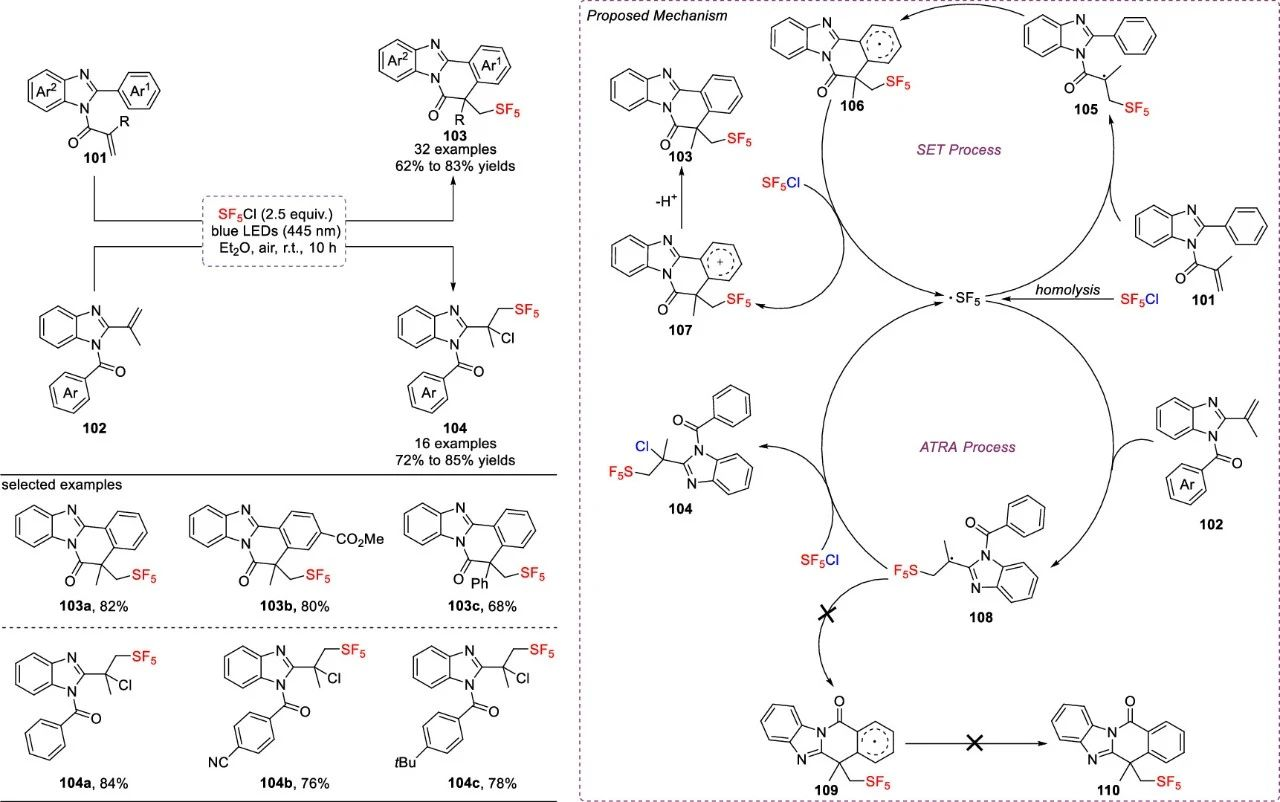
Between 2023 and 2024, the Bizet research group realized the functionalization of pentafluorosulfanyl alkynes using SF₅Cl as a raw material: due to the strong electron-withdrawing effect of the SF₅ group, the carbon atom in phenylacetylene derivative (113) that is farther from SF₅ is more susceptible to nucleophilic attack. By using sodium hydride as the base, the team successfully synthesized a series of new pentafluorosulfanyl alkenes (114), with most products having moderate to excellent yields, demonstrating the universality of this method.
2. Reactions of SF₅Cl with Diazo Compounds
In addition to alkenes and alkynes, SF₅Cl can also react with carbenes. Based on this, the Qing research group developed a series of diazo compounds as carbene precursors, which react with SF₅Cl in the presence of potassium fluoride to prepare α-pentafluorosulfanyl-substituted ketones (116) with moderate yields. The diverse substrates used in this method highlight its practical value in expanding the reactivity of SF₅Cl.
From a mechanistic perspective, the reaction undergoes a free radical process: first, SF₅ radicals are generated through reaction with diazo compounds (115) or photoexcitation; then they react with (115) to form radical (117), which spontaneously releases nitrogen to generate radical (118); finally, the target product is formed through a hydrogen atom transfer (HAT) process.
Under the same conditions, SF₅Cl can also participate in free radical cascade reactions. The SF₅ radical reacts with the diazo compound to form a radical intermediate (117), which then reacts with a radical acceptor to generate α-alkyl-α-SF₅ carbonyl compounds (122/123) and furan derivatives (124).
Under copper catalysis, the reaction can chemoselectively obtain α-chloro-α-SF₅ ketones (125): at room temperature, with Cu(MeCN)₄PF₆ as the catalyst and 4,7-diphenyl-1,10-phenanthroline as the ligand, the diazo compound (115) reacts with SF₅Cl in dichloromethane for half an hour to generate the target product. Mechanism studies show that the Cu(I) complex (126) first reduces SF₅Cl to generate SF₅ radicals, which then react with the diazo compound (115) to generate intermediate (117); after the intermediate eliminates nitrogen molecules, it forms radical (118), which inserts into the Cu(II) complex (127) and undergoes reductive elimination to obtain the product (125), while (127) is reduced to (126) to complete the catalytic cycle.
3. Strain-Release-Driven Pentafluorosulfanylation Reactions Involving SF₅Cl
In 2022, the Cornella and Pitts teams realized the addition reaction of [1.1.1]propellane (128) with SF₅Cl: under light irradiation at 30°C in diethyl ether solvent, this strain-release-driven reaction successfully constructed the C(sp³)-SF₅ bond, providing an important supplement to the aforementioned π-system addition strategy.
In 2023, the Qing research group reported the reaction of SF₅Cl with [1.1.1]propellane (128) and diiodomethane in a mixed solvent of n-hexane/diethyl ether: stirring at room temperature for 3 hours can realize the iodopentafluorosulfanylation reaction of (128), and the reaction can be scaled up to the gram level, and the obtained product iodopentafluorosulfanyl bicyclo[1.1.1]pentane (131, SF₅−BCP−I) has good stability. Under blue light irradiation, SF₅−BCP−I can undergo free radical addition reactions with alkenes/alkynes in cyclohexane under the catalysis of Ir[dF(CF₃ppy)]₂(dtbbpy)PF₆, which requires tris(trimethylsilyl)silane [(TMS)₃SiH] as the hydrogen source and 2 equivalents of K₃PO₄ as the base. In addition, under the catalysis of Cu(MeCN)₄PF₆ and PCy₃, SF₅Cl can also react with (128) and diphenyl disulfide to generate SF₅−BCP−SPh compound (130).
In 2024, the Tantillo and Pitts teams found that under white light irradiation, SF₅Cl can not only add to alkenes/alkynes but also react with bicyclo[1.1.0]butane (136): the addition product (137) can be obtained with moderate yield by simply irradiating a mixture of (136) and SF₅Cl in ethyl acetate with white light. Studies have also shown that the addition of copper(II) bromide can significantly improve the trans stereoselectivity of the product, but its regulation mechanism remains to be clarified.
After completing the above addition reaction, by adding Co(acac)₂ and NaBH₄ and replacing the solvent with methanol, the hydrogen substitution of the chlorine atom can be realized, and the corresponding reduction product (138) can be obtained with a maximum yield of 80%.
In 2025, the Pitts and Tantillo teams realized the synthesis of N-SF₅ azetidine (140) through strain-release functionalization of 3-substituted [1.1.0]azabicyclobutane (139): the reaction is carried out in THF under blue light irradiation, with SF₅Cl dissolved in n-hexane reacting with (139), showing broad compatibility with 3-aryl substituents. DFT calculations show that the SF₅ radical preferentially adds to the nitrogen atom to form a thermodynamically favorable intermediate (with steric hindrance smaller than that of the carbon-centered pathway), and single-crystal X-ray diffraction (SC-XRD) confirms that the dominant configuration in the solid state is the cis isomer.
The Tlili research group established a strain-release-driven strategy through the imine N-SF₅ reagent (143), successfully synthesizing pentafluorosulfanylated four-membered rings (144) and (145): the reaction is carried out in ethyl acetate under 405 nm light irradiation and thioxanthone (TXO) catalysis, with moderate to excellent yields. Mechanism studies show that photoexcited TXO induces N-S bond homolysis to generate SF₅ radicals, which add to the strained ring system and form products through free radical chain reactions.
In biological research, N-SF₅-modified spleen tyrosine kinase (SYK) inhibitors show significantly enhanced lipophilicity (log D7.4>5, while the N-SO₂Me analog is only 2.1), and the increase in hepatic microsomal intrinsic clearance is limited, confirming that N-SF₅ can be used as a sulfonamide bioisostere. The Tlili research group further found that (144a) is hydrolyzed in 1M HCl/diethyl ether at 50°C to generate ammonium salt (149), which is deprotonated by NaHCO₃ (water-saturated solution) to obtain primary amine (150); the primary amine reacts with benzaldehyde in methanol/dichloromethane through reductive amination to prepare secondary amine (151), which shows excellent stability in various media (no decomposition within 24 hours), highlighting the potential of the azetidine-SF₅ skeleton in the synthesis of complex molecules and drug development.
4. Synthesis of SF₅-Containing Compounds by Activating SF₆
In addition to SF₅Cl, low-toxicity and stable SF₆ is also an ideal pentafluorosulfanyl precursor, but its high inertness makes it challenging to utilize. In 2018, the Beier team reported a method for generating SF₅ radicals by reducing SF₆ with lithium 2,2,6,6-tetramethylpiperidide (TEMPOLi): TEMPOLi reacts with SF₆ to generate SF₅ radicals and lithium fluoride, and the radicals react with alkenes to form carbon radicals, which then combine with 2,2,6,6-tetramethylpiperidinoxyl (TEMPO, 153) or 1,1,3,3-tetramethylisoindolinoxyl (TMINO, 154) to obtain aliphatic SF₅ compounds (156) and (157) with yields of 1.5-3.5%.
In 2018, the Wagenknecht team reported the pentafluorosulfanylation reaction of α-methyl/α-phenylstyrenes: the study uses N-phenylphenothiazine (PPTZ) as a photosensitizer, which generates excited-state PPTZ* under 365 nm light excitation, and transfers electrons to SF₆ to dissociate it into SF₅ radicals and fluoride anions, while PPTZ is converted to the radical cation PPTZ•+. The cation is excited by 525 nm light to form PPTZ•+, which can oxidize alkene (158) to generate the alkene radical cation (158•+) (PPTZ•+ returns to the ground state). (158•+) combines with the SF₅ radical to form a cationic intermediate (161), which then reacts with the fluoride anion and undergoes HF elimination after treatment with boron trifluoride to finally obtain the SF₅-substituted alkene product (160). In the reaction, copper acetate plays a key role in the catalytic cycle by coordinating and stabilizing radicals (prolonging the lifetime of SF₅ radicals and alkene radical cations).
In 2019, based on the above SF₅ radical generation strategy, the team successfully realized the alkoxypentafluorosulfanylation reaction of α-substituted styrenes (162): different from the previous method, in the presence of alcohol, the alkene radical cation intermediate (161) first reacts with alcohol to generate a primary carbon radical intermediate, which then combines with the SF₅ radical to obtain SF₅-containing ether compounds (163) with moderate yields.
In 2021, based on their previous work, the Wagenknecht team further developed a pentafluorosulfanylation domino cyclization reaction of α-substituted alkenes, successfully constructing oxygen heterocycles (166): when terminal alkynol (165) is used as the substrate, the alkene radical cation intermediate (161) first reacts with the hydroxyl group to form a primary carbon radical, then undergoes intramolecular addition to generate a vinyl radical, and finally combines with the SF₅ radical to generate the SF₅-containing oxygen heterocyclic compound (166).
In 2025, the Zhao team reported a similar SF₆ activation strategy: under 380-400 nm light irradiation, styrylpyrrolidone (167) reacts with SF₆ in a mixed solvent of ethyl acetate/methanol, with N-phenylphenothiazine (PPTZ) as the photocatalyst and tetrabutylammonium chloride (TBAC) as the additive, generating an SF₅-containing enamine intermediate, which is acidified with hydrochloric acid to obtain α-SF₅ functionalized ketones (168). Although only three substrates are shown, this study opens up a new way to utilize SF₆ reactivity under mild photocatalytic conditions.
5. Development of New Pentafluorosulfanylation Reagents
The Paquin research group recently developed a new pentafluorosulfanylation reagent system: using vinyl acetate (51) as the starting material, trifluoromethanesulfonate (53) is obtained through SF₅Cl addition and trifluoromethanesulfonic anhydride treatment; the intermediate reacts with thioacetic acid/cesium carbonate in acetonitrile to convert to S-[2-(pentafluoro-λ⁶-sulfanyl)ethyl]ethanethioate (169); finally, it is treated with 3M hydrochloric acid and sodium hypochlorite in dichloromethane to prepare the final reagent 2-(pentafluoro-λ⁶-sulfanyl)ethane-1-sulfonyl chloride (170). This reagent generates SF₅ radicals under thioxanthone photosensitization and can react with enol acetates (171) to efficiently generate α-SF₅ substituted ketones (172).

In 2025, the Tlili research group designed and developed a new N-SF₅ imine reagent (178), successfully realizing the pentafluorosulfanylation of styrene and its derivatives: based on the previous work of the De Borggraeve and Demaerel teams, 2,3,4,5,6-pentafluorobenzamide (174) reacts with sulfur powder, TCCA, and tetrabutylammonium bromide (TBAB) in acetonitrile at 40°C to prepare intermediate (175), which is filtered in a glove box and reacted with AgF₂ to generate NSF₃ gas. Through a CO-ware device, the gas reacts with potassium fluoride/TCCA to obtain Cl₂NSF₅ (176) with a 50% yield, and its n-hexane solution reacts with diazo compound (177) in dichloromethane at 40°C to finally generate the imine-SF₅ reagent (178). This reaction is also applicable to benzene ester-substituted diazo compounds, and single-crystal X-ray diffraction (SC-XRD) and NMR analysis show that the SF₅ group always preferentially orients towards the ester group, while methyl substitution at the ortho position of the aromatic ring causes cis-trans isomerism.
Stability tests of compound (143a) show that it performs excellently in most solvents, with only 10% decomposition after 96 hours in pH 10 buffer. Cyclic voltammetry determines its reduction potential to be -1.62 V (vs Ag/Ag⁺), confirming that this compound can be used as an SF₅ radical precursor. Inspired by the Glorius team, a model reaction was used to study the N-SF₅ bond homolysis process under photoinduced energy transfer catalysis: under 405 nm light irradiation, styrene derivatives react with (143a) in ethyl acetate under TXO catalysis to obtain imine-pentafluorosulfanylated adducts (179) with moderate to excellent yields. EPR spectroscopy combined with the radical trapping agent 5,5-dimethyl-1-pyrroline-N-oxide (DMPO) confirms the existence of nitrogen, sulfur, and carbon-centered radicals, and the high quantum yield of 7.8 further confirms the free radical chain mechanism: photoexcited TXO induces N-S bond homolysis of (143) through energy transfer, generating imine radicals (146) and SF₅ radicals; the latter adds to styrene to form carbon-centered radicals (180), which react
This reagent can also achieve the hydro-pentafluorosulfanylation reaction of styrene and its derivatives under 455 nm light irradiation: Under the catalysis of [Ir(dF(CF₃)ppy)₂(dtbbpy)]PF₆ and in the presence of Hantzsch ester (HEH), product 182 is generated. Deuterium labeling experiments (24% deuterium incorporation when using DCl), EPR radical trapping studies, and a quantum yield of 8.8 together confirmed the reaction mechanism: Photoexcited Ir(III) is reduced by HEH to Ir(II), which activates 143a through single electron transfer (SET) to generate SF₅ radicals and imine anion 184; the SF₅ radical adds to styrene to form carbon-centered radical 186, which is reduced to carbanion intermediate 187 by Ir(II) or the HEH-derived radical (HE·), and finally protonated to obtain 182. Compared with SF₅Cl, 143a has better stability and milder reaction conditions, demonstrating significant synthetic advantages.
Aladdin:https://www.aladdinsci.com