
Why Carbazole Is So Common in OLEDs: Managing Charge Carriers, Excitons, and Film Morphology with a Building-Block Mindset (with Selection Guide and Tables 1–3)
1.Why “High Efficiency” ≠ “Long-Term Robustness”: The Real Bottlenecks Behind Lifetime and Consistency
In OLEDs and other organic optoelectronic devices, many formulations can look highly efficient in early lab-scale tests. But once you switch batches, change film thickness, adjust the evaporation/spin-coating window, or push devices into long-term operation, three familiar issues often appear:
1. Luminance and efficiency drift with driving conditions, and the recombination (emission) zone becomes unstable.
2. Lifetime drops, or the same formulation shows large batch-to-batch fluctuations.
3. Under thermal and electric fields, the thin film morphology evolves (more prone to crystallization, phase separation, or the formation of additional trap states).
These problems are often not about whether “a molecule can emit light.” They are device-level, system outcomes: energy-level alignment affects injection/blocking; carrier balance determines the recombination zone and local stress; excitons must be effectively confined and protected from quenching; and the film must maintain a stable morphology under operating conditions. Together, these factors dictate efficiency drift, operational lifetime, and batch consistency.
This is why, in high-performance OLED design, the “host material + doped emitter” architecture is so widespread: the host does much of the work of stabilizing the system. At the same time, host materials often need to strike a balance—or be combined strategically—between unipolar transport (more hole- or electron-side) and bipolar transport (addressing both sides).
Among the many usable fragments, carbazole is one of the most common and most mature scaffolds for host and hole-side design in OLEDs. In molecular design, it often provides (i) a hole-leaning tendency, (ii) relatively high triplet energy, and (iii) thermal/morphological stability arising from scaffold rigidity (the actual outcome still depends on substitution patterns and linkage topology). Note: It is not the only option—other high-T₁, high-stability fragments are also widely used for similar goals and should be screened head-to-head within the same device context.
2.Definitions and Core Concepts: From Heterocycles to Carbazole, and Then to “Building Blocks”
2.1 Heterocycles and Heteroarenes
1. Heterocyclic compounds: cyclic structures containing at least one non-carbon atom (commonly N/O/S, etc.).
2. Heteroarenes / hetarenes: aromatic heterocycles that can be viewed as arene frameworks where some –C= or –CH=CH– units are replaced by heteroatoms, forming an aromatic ring system (a continuous π system meeting aromaticity criteria; Hückel’s 4n+2 rule is a commonly used simplified criterion).
2.2 Carbazole and Carbazole Derivatives
1. Carbazole (typically 9H-carbazole): a fused tricyclic aromatic nitrogen heterocycle. It can be understood as a rigid, planar framework formed by fusing a pyrrole-like five-membered N-containing ring with two benzene rings. “9H” indicates that the nitrogen (position 9) bears a hydrogen (N–H).
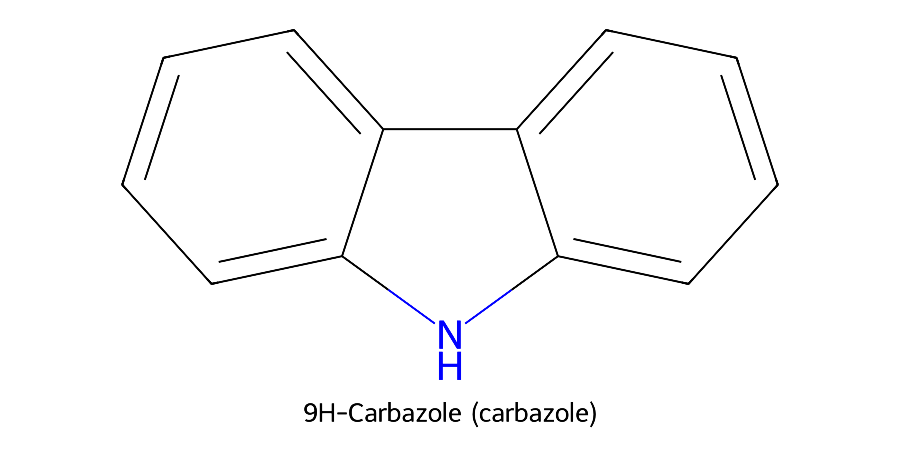
2. Carbazole derivatives: materials built on the carbazole core, where N-9 substitution and/or carbon-site substitution on the rings introduces connection points, solubility tuning, and electronic effects—allowing the same core to be “parameter-tuned” into properties needed for different device tasks.
2.3 What “Building Blocks” Mean in Materials Chemistry
“Building block” is an engineering-oriented term in materials synthesis. It refers to a structural unit that is stable and readily available, has well-defined and functionalizable positions, and can be assembled as a module into larger molecules/polymers/interfacial layers (facilitating both scale-up synthesis and modular, function-driven tuning).
Carbazole is often called a “heterocyclic building block” largely because it typically satisfies three conditions:
1. A stable and relatively rigid scaffold, helping stabilize both structure and morphology.
2. Multiple controllable linkage/substitution sites, enabling the introduction of linkers, side chains, or functional fragments.
3. Often donor-like with a relatively high HOMO (in many common design motifs), so carbazole units are frequently used as hole-transport / donor-related fragments (the actual transport behavior still varies with substitution and the overall system).
2.4 Quick Reference Table of Key Terms
Term | How to understand it | What it is used to explain in OLEDs / materials |
Heterocycle | A ring containing at least one heteroatom (not all-carbon; commonly N/O/S) | Why certain scaffolds lead to different energy levels, polarity, coordination/interactions, and stability |
Heteroarene | An aromatic heterocycle (continuous π system meeting aromaticity criteria) | How aromaticity impacts energy-level positions, rigidity, chemical stability, and charge-transport tendencies |
Carbazole | A fused tricyclic aromatic N-containing scaffold, often referring to 9H-carbazole (N–H) | As a common “core/module,” why it appears frequently in hole-related materials and host design |
Carbazolyl | Carbazole used as a substituent attached to another molecule; most common is carbazol-9-yl (linked via N-9) | When you see “carbazolyl-,” it usually means “using a carbazole unit to assemble a larger molecule/polymer” |
Host | The “matrix material” in the emissive layer: supports the doped emitter and participates in charge/energy management and morphological stability | Why the same emitter can show very different efficiency/lifetime/consistency when the host changes |
Triplet energy | The T₁ excited-state energy (often in eV) | Mainly for exciton confinement in phosphorescent OLEDs and most TADF systems: host T₁ is often desired to be higher than the emitter to reduce back-transfer/quenching risk; for purely fluorescent systems, T₁ is often not the primary metric and must be judged alongside S₁, carrier balance, and morphology |
HTM (hole-transport material) | A material responsible for hole injection and transport (can be a dedicated layer, or a molecule/polymer) | Explains how to achieve “carrier balance”: holes moving too fast/too slow shifts the recombination zone and impacts efficiency drift and lifetime |
3.How Carbazole Is “Tuned”: Connection Site × Molecular Shape × Donor–Acceptor Pairing
Carbazole is widely used as a materials unit because it offers several practical structural knobs: where to connect, what shape/size to build, and what to pair it with. These choices directly affect film formation, packing, carrier balance, and device stability.
3.1 Where You Connect Determines “How You Assemble” and “How It Packs”
1. N-9 substitution (N-linked connection): commonly used to attach side chains or bulky substituents to improve solubility, suppress excessive aggregation/crystallization, and broaden the processing window for film formation. It can also change energy levels and conformation—generally, the stronger/bulkier the substituent, the more pronounced the impact.
2. Ring carbon-site linkage (e.g., 2,7 / 3,6, etc.): more often used to define the conjugation pathway and scaffold extension, influencing molecular planarity, π–π stacking, and thin-film morphology. Empirically, 2,7 vs 3,6 connectivity can lead to different conjugation routes and packing modes, and is frequently used to trade off between “stronger conjugation / more stacking-prone” and “more amorphous / more morphologically robust films.”
3.2 Making It “More 3D / Larger” Is a Common Way to Stabilize the Film
When the focus shifts from single-molecule metrics to long-term film stability, multi-armed or dendritic carbazole derivatives are often used to:
1. Increase the tendency toward glass formation and morphological stability (less likely to crystallize or phase-separate).
2. Broaden the reproducible processing window, making it easier to obtain similar film states under process fluctuations.
Caution: making a molecule larger and more three-dimensional often improves film formation, but it can also slow charge transport, reduce compatibility with dopants, or increase the risk of stratification/phase separation within the film. The best way to judge whether it helps is to run controlled comparisons under the same device conditions.
3.3 Pairing with Acceptor Fragments Helps Pull Carrier Balance Back into a “More Stable” Regime
If a material exhibits strongly hole-side characteristics, devices can easily suffer from carrier imbalance and recombination-zone drift. A common strategy is to combine carbazole (donor-leaning / hole-side) with acceptor fragments, forming a more bipolar-transport host design and using structure to tune, simultaneously:
1. HOMO/LUMO levels and injection/blocking,
2. Recombination-zone position and exciton confinement,
3. Film morphology (excessive polarity or overly strong interactions can also introduce new phase-separation risks).
4.Why Carbazole Fragments Are So Common in OLED Host Materials
The emissive layer in OLEDs typically adopts a “host + doped emitter” architecture. To push a device from merely “high efficiency” toward long lifetime and better batch-to-batch consistency, the host material often needs to simultaneously suppress exciton losses, stabilize the recombination-zone position, and maintain a stable thin-film morphology under thermal and electric fields.
Carbazole fragments are widely used in host design largely because they often provide three useful types of properties:
1. Hole-leaning / donor character (a design tendency toward a relatively high HOMO), which helps stabilize issues related to hole injection and transport;
2. A tendency toward higher triplet energy (structure-dependent), making them more commonly adopted in systems that rely heavily on exciton confinement and energy management, such as phosphorescent OLEDs and most TADF designs;
3. Multiple linkage and functionalization entry points, making it easier to tune solubility, film formation, and energy-level matching on the same core scaffold.
Therefore, when the goal is to improve stability and reproducibility during long-term operation, carbazole units are often used to build the host’s “hole-side capability,” and then paired with more electron-leaning fragments to achieve more stable carrier balance and recombination-zone control.
5.Classification of Carbazole Derivatives: Grouped by Their Roles in Devices
Category | Position / task in the device | Core capabilities provided by carbazole building blocks |
Hosts and host fragments for OLED emissive layers | Manage excitons and charge carriers; improve thin-film stability | High triplet energy and hole-side capability; readily functionalized for structural tuning and bipolar design |
Hole-transport materials (HTMs) | Promote hole injection and transport; reduce interfacial and transport losses | Carbazole units often exhibit strong hole-side characteristics and high design flexibility |
Photoconductive polymers and related systems (PVK/PVCz) | Photogenerated carrier generation and transport; film-forming matrix | PVK thin films have extensive classical studies on hole transport and photoconductive behavior |
6.Selecting Carbazole Building Blocks by Device Bottleneck: Goal → Common Approach → What You Typically Observe
What you want to improve first | Common carbazole-building-block approach | Why this helps (what you typically observe in devices) |
Insufficient hole-side capability, recombination-zone shift, carrier imbalance | Use carbazole units as donor/hole-side modules and pair them with electron-side fragments (a more “bipolar” host concept) | Carbazole units are often used to pull hole-side capability and energy-level matching back into a more controllable range; pairing with electron-side fragments makes it easier to stabilize charge balance and the recombination-zone position |
Excitons easily leak out / get quenched; you want more “excitonic headroom” | Prioritize host designs containing carbazole units with a more suitable T₁ (or related energy-level window) | Many carbazole-related host designs tend to offer higher T₁ / stronger confinement potential, reducing losses caused by exciton migration/leakage (but the final judgment should rely on measured/computed energy levels for that specific molecule) |
Films readily crystallize/phase-separate; lifetime and batch consistency fluctuate | Use multi-carbazole / multi-armed / dendritic or more rigid carbazole-derived structures (together with side-chain / steric designs) | Such structures are often used to suppress excessive packing and crystallization and to broaden the film-forming window, making stable films easier to obtain; however, they can also sacrifice mobility, dopant miscibility, or phase behavior—so you need same-condition controls to confirm whether this actually hits your bottleneck |
Practical tip: First use device behavior to diagnose whether the bottleneck is mainly charge, exciton, or morphology. Then select a building-block strategy from the table, and finally run controlled comparisons under the same device conditions to verify that any benefit truly lands on the bottleneck.
7.Product Navigation Table|Carbazole Chemicals: Choose the Right Product Table (Tables 1–3) from the Application Scenario
Research / experimental need | Recommended table to check first | Selection logic | Representative products in that table |
Build/modify a carbazole scaffold from scratch: need coupling-ready entry points with defined positions (assembling scaffolds for Host/HTM/TADF) | Table 1: Synthesis & Basics | First lock down controllable connection sites and the “building-block form”: dibromo (2,7/3,6) determines extension mode; boronic acids define Suzuki assembly entry points; parent/functionalized cores are the starting points for tuning | 2,7-Dibromocarbazole (D123548); 3,6-Dibromocarbazole (D101983); (9H-Carbazol-3-yl)boronic acid (B728804); Carbazole (C104874) |
The same formulation shows batch-to-batch variation / lifetime fluctuations: suspect unstable morphology (crystallization/phase separation/trap-state growth) | Table 2: Device Molecules (OLED Host/HTL/TADF) | These issues are often driven by Tg and morphological stability of host/transport-layer materials; start with mature Host/HTL as benchmarks to quickly judge whether drift comes from the material platform | T290117 (high-Tg CzSi-type host); CBP (B113207); mCP (B121604); TCTA (T123987) |
Selecting a Host for OLED emissive layers: phosphorescence/TADF; worried about exciton management (back-transfer/quenching) and carrier balance | Table 2: Device Molecules (OLED Host/HTL/TADF) | Host selection centers on “exciton energy management + charge balance + film-forming stability”; Table 2 concentrates high-frequency industry host platforms, bipolar hosts, and TADF anchor materials—ideal for platform screening before fine tuning | CBP (B113207); mCP (B121604); pCP (D972201); tCP (T123337); 26DCzPPy (B152016); TRZ-D–A host (D290088) |
Deep-blue / high-energy-level systems: need higher Tg, more stable films, and device-grade materials suitable for vacuum deposition | Table 2: Device Molecules (OLED Host/HTL/TADF) | Deep-blue/high-energy systems amplify morphology drift and impurity effects; start from sublimation-grade hosts and use a “high-Tg platform” to stabilize lifetime/consistency first | T290117 (sublimation grade, ≥99%); m-CBP (M478484, sublimation grade) |
Interface engineering in perovskite/organic optoelectronics: improve Voc/FF/stability; suspect interfacial energy-level alignment and recombination | Table 3: Interfacial SAMs (PACz) | Use SAMs (phosphonic-acid anchoring) to turn “interface dipole / wetting / energy-level matching” into controllable variables; PACz is the most common carbazole-based interface platform for systematic comparisons | 2PACz (P405551); 4PACz (P1324821); MeO-2PACz (M404348); F-2PACz (D1504934) |
Same device stack but performance collapses after changing substrate/process: suspect inconsistent wetting/coverage (poor interfacial film formation causing batch variation) | Table 3: Interfacial SAMs (PACz) | Wetting and coverage differences directly trigger inconsistent interfacial recombination and charge extraction; Table 3 offers controlled comparison sets by “chain length (2 vs 4) + substituent (Me/OMe/F)” | 2PACz vs 4PACz; Me-2PACz (D1504935) / Me-4PACz (D494218); MeO-2PACz (M404348) |
Need a “hole-selective contact” or want to optimize hole extraction/injection while reducing interfacial hysteresis and ion-migration effects | Table 3: Interfacial SAMs (PACz) | PACz provides stable anchoring and a tunable interfacial dipole, commonly used to build a more stable hole-selective contact; use 2PACz as baseline, then fine-tune with substituents/chain length | 2PACz (P405551); MeO-2PACz (M404348); 4PACz (P1324821) |
Photoconductive/polymer matrix work (or need carbazole polymers as carriers/film-forming platforms) | Table 1: Synthesis & Basics | PVK is a “matrix/carrier” material rather than a small-molecule host; molecular weight strongly affects film formation and charge-transport windows, so it should be directly compared and selected within Table 1 | PVK (P121309, Mw≈90,000); PVK (P753859, Mn≈400,000–500,000); N-vinylcarbazole (V109376) |
Analytical/method-development/impurity control: need reliable references (mp/analytical standards) or use the parent core for spectral benchmarking | Table 1: Synthesis & Basics | Separate “reference/standards” from “actual synthesis/device feedstocks”: standards support qualitative/quantitative method validation; the parent core is for upstream synthetic starting points | Carbazole (C119537 melting-point standard; C104876 analytical standard; C104874 ≥97%) |
Note: PACz refers to interfacial molecular layers aimed at hole-selective contacts in perovskite/organic optoelectronics.
Table 1|Synthesis & Basics (Parent Core / Standards / Substituted Cores / Coupling Monomers / Polymers)
Category | CAS No. | Aladdin Cat. No. | Name | Spec / Purity | Key features & applications |
Parent core | Standard (reference / qualitative & quantitative) | 86-74-8 | Carbazole | Melting-point standard | Parent-core standard: used for identification, melting point/purity benchmarking, and method validation; also a foundational reference for carbazole-derivative synthesis and materials research. | |
Parent core | Standard (reference / qualitative & quantitative) | 86-74-8 | Carbazole | Analytical standard | Parent-core analytical reference: convenient for HPLC/GC/spectra comparison and impurity control; supports batch-consistency evaluation in materials and synthesis. | |
Parent core | Basic reagent (synthetic starting point) | 86-74-8 | Carbazole | ≥97% (GC) | Common starting material in synthesis and materials R&D: used to prepare N-substituted derivatives, 3,6/2,7-position functionalization, and upstream building blocks for various Host/HTM/SAM materials. | |
N-Substituted carbazole | Small-molecule hole-side / solubility tuning | 86-28-2 | N-Ethylcarbazole | ≥97% | Typical N-alkyl carbazole: often used as a benchmark for hole-side properties and solubility/film-forming behavior; can also serve as an upstream building block to introduce flexible side chains. | |
N-Substituted carbazole | Basic building block / hole-side fragment | 1150-62-5 | 9-Phenylcarbazole | ≥98% | Common N-aryl carbazole building block: used for further functionalization/coupling to construct Host/HTM materials; also used to introduce hole-side fragments and tune packing/energy levels. | |
Substituted core | Steric / high-Tg tuning building block | 37500-95-1 | 3,6-Di-tert-butylcarbazole | ≥99% | Large steric bulk at 3,6 positions: often used to increase solubility, suppress excessive aggregation/crystallization, and improve thermal/morphological stability; commonly used as an upstream building block for HTM/Host/TADF molecules. | |
Substituted core | Electron-donating / energy-level & morphology tuning | 5599-50-8 | 3,6-Dimethylcarbazole | ≥98% | 3,6-Dimethyl substitution tunes electronic effects and packing: often incorporated as a building block to optimize energy levels, film formation, and device stability; useful in Host/HTM/D–A molecular design. | |
Substituted core | Stronger donation (OMe) / tunable energy levels | 57103-01-2 | 3,6-Dimethoxy-9H-carbazole | ≥98% | 3,6-Dimethoxy is a common electron-donating substitution: used to enhance hole-side capability and tune HOMO/interfacial alignment; frequently seen in HTM/SAM variants and D–A structural tuning. | |
Synthetic building block | Halogenated monomer (2,7 positions; polymerization/coupling entry) | 136630-39-2 | 2,7-Dibromocarbazole | ≥98% | High-frequency “position-defined” monomer: used in Suzuki/Stille/Buchwald couplings to build linearly extended carbazole scaffolds, conjugated small molecules, and polymer monomers. | |
Synthetic building block | Halogenated monomer (3,6 positions; polymerization/coupling entry) | 6825-20-3 | 3,6-Dibromocarbazole | ≥98% | One of the most widely used coupling monomers: used to build multi-carbazole, star-shaped, dendritic molecules and conjugated-material backbones, supporting OLED Host/HTL design and stability tuning. | |
Synthetic building block | Suzuki boronic-acid monomer (introducing carbazole fragments) | 851524-97-5 | (9H-Carbazol-3-yl)boronic acid | ≥95% | Typical “carbazole building-block” boronic acid: used in Suzuki–Miyaura coupling to install carbazole fragments onto biaryl/acceptor frameworks; commonly used in OLED host/HTL, D–A molecules, and conjugated polymer monomer construction. | |
Polymerizable monomer | PVK monomer entry | 1484-13-5 | N-Vinylcarbazole | ≥98% | Key monomer for PVK (poly(N-vinylcarbazole)): used to prepare photoconductive/charge-transport polymer matrices; representative in photoconductivity and OLED material systems. | |
Polymer | PVK (photoconductive / charge-transport matrix) | 25067-59-8 | Poly(9-vinylcarbazole) | Approx. Mw 90,000 | Classic carbazole polymer matrix: used in photoconductivity, carrier transport, and thin-film formation studies; also serves as a polymer host/carrier for composite films and doped systems. | |
Polymer | PVK (different molecular-weight grade) | 25067-59-8 | Poly(9-vinylcarbazole) (PVK) | average Mn 400,000–500,000 | Different PVK molecular-weight grades affect film formation, glass transition behavior, and the charge-transport window; for system optimization it can be compared in parallel with PVK at Mw ≈ 90,000. |
Table 2|Device Molecules (OLED Hosts / HTL / Bipolar Hosts / TADF)
Category | CAS No. | Aladdin Cat. No. | Name | Spec / Purity | Key features & applications |
OLED Host | CBP (classic host benchmark) | 58328-31-7 | 4,4′-Bis(N-carbazolyl)-1,1′-biphenyl | ≥98% | One of the most classic host materials in OLEDs (host benchmark): widely used as a carrier/reference host for phosphorescent/TADF emissive layers; convenient for comparing energy, charge, and lifetime windows against other hosts. | |
OLED Host | m-CBP (device-grade purity) | 342638-54-4 | m-CBP | Sublimation grade | Sublimation-grade m-CBP: intended for OLED device-purity needs; used for host/carrier and lifetime/efficiency benchmark evaluations. | |
OLED Host | mCP (high-triplet-energy host) | 550378-78-4 | 1,3-Di(9H-carbazol-9-yl)benzene (mCP) | ≥98% | One of the classic OLED host materials: often used as a host or as a charge/exciton-blocking-layer candidate in phosphorescent/TADF stacks; valued for relatively high triplet energy and film-forming stability. | |
OLED Host | pCP (di(carbazolyl)benzene host) | 19287-68-4 | 1,4-Di(9H-carbazol-9-yl)benzene | ≥95% | Di(carbazolyl)benzene host: used for OLED host/carrier and energy-management benchmarking; commonly paired as a reference with mCP within the “carbazole host” family. | |
OLED Host | Multi-carbazole aryl host (high T₁ / morphological stability) | 148044-07-9 | 1,3,5-Tris(9H-carbazol-9-yl)benzene | ≥98% (HPLC) | Rigid multi-carbazole host: used as an emissive-layer host/carrier (especially in blue/high-energy systems) to improve film stability and provide hole-side capability; also serves as a scaffold for energy management and charge-balance design. | |
OLED HTL/Host | TCTA (strong hole-side; often HTL/EBL) | 139092-78-7 | Tris(4-carbazol-9-ylphenyl)amine (TCTA) | ≥98% | Widely used hole-transport/exciton-blocking material (HTL/EBL) and host candidate: strong hole-side capability, often used to improve carrier balance and stabilize the recombination zone. | |
OLED Host | Bipolar host (charge balance) | 1013405-24-7 | 2,6-Bis[3-(9H-carbazol-9-yl)phenyl]pyridine | ≥98% | Representative bipolar host: carbazole provides the hole side, while the pyridine acceptor end strengthens the electron side/balance; used to improve carrier balance and recombination-zone stability in OLEDs. | |
OLED Host | D–A host / acceptor end (TRZ) | 440354-93-8 | 9-(4-(4,6-Diphenyl-1,3,5-triazin-2-yl)phenyl)-9H-carbazole | Sublimation grade, ≥99% (HPLC) | Typical D–A structure: carbazole donor + triazine acceptor, used for bipolar hosts, carrier balance, and exciton management; sublimation grade is better suited to OLED device materials. | |
OLED Host | mCBP (CBP isomer / reference host) | 342638-54-4 | 3,3′-Di(9H-carbazol-9-yl)-1,1′-biphenyl | ≥98% | Often used as a CBP-family isomer/reference material (useful for comparing film formation, energy levels, and morphology windows); applied in OLED host and energy/charge-management studies. | |
OLED Host | High-Tg deep-blue/high-energy host (CzSi family; sublimation-grade device material) | 898546-82-2 | 9-(4-tert-Butylphenyl)-3,6-bis(triphenylsilyl)-9H-carbazole | Sublimation grade, ≥99% | Typical CzSi-type carbazole host: bulky –SiPh₃ substituents at 3,6 positions improve thermal/morphological stability and suppress crystallization/phase separation; commonly used as an emissive-layer host/carrier (especially deep-blue/high-energy systems) and a candidate for lifetime/stability optimization; sublimation grade meets high-purity requirements for evaporated devices. | |
TADF emitter / model molecule (D–A/CT anchor) | 2CzPN (D–A anchor) | 1416881-50-9 | 4,5-Bis(9-carbazolyl)phthalonitrile | ≥98% (HPLC) | Typical D–A scaffold (carbazole donor + dinitrile acceptor): used in TADF/emissive-material research and mechanism validation; also used to illustrate how CT states and energy management affect device performance. | |
TADF emitter / photoredox anchor | 4CzIPN (D–A anchor) | 1416881-52-1 | 2,4,5,6-Tetrakis(9-carbazolyl)isophthalonitrile | ≥99% (HPLC) | Representative D–A system (carbazole donor + dinitrile acceptor): widely used as a visible-light photoredox catalyst and as a TADF research anchor; often used to explain “donor/acceptor/charge-transfer state” logic in emission and energy management. |
Table 3|Interfacial SAMs (PACz Series and Variants)
Category | CAS No. | Aladdin Cat. No. | Name | Spec / Purity | Key features & applications |
Interfacial SAM | 2PACz (benchmark carbazole phosphonic acid) | 20999-38-6 | [2-(9H-Carbazol-9-yl)ethyl]phosphonic acid (2PACz) | ≥98% | Classic carbazole–phosphonic-acid SAM: used to tune interfacial energy levels and interfacial recombination at electrode/perovskite/organic interfaces; often used as a “baseline interface molecule” for systematic comparison and optimization. | |
Interfacial SAM | 4PACz (chain-length comparison) | 20999-36-4 | [4-(9H-Carbazol-9-yl)butyl]phosphonic acid | ≥98% | A key reference within the PACz series: relative to 2PACz, changes chain length and packing mode; used to compare differences in interfacial dipole, wetting, and device stability. | |
Interfacial SAM | MeO-2PACz (tuning energy levels / wetting / interfacial recombination) | 2377770-18-6 | MeO-2PACz | ≥98% | Common variant of carbazole–phosphonic-acid SAM: OMe substitution tunes interfacial dipole and wetting/film-formation window; widely used as a hole-selective contact layer in perovskite/organic optoelectronic devices. | |
Interfacial SAM | Me-2PACz (chain-length/substituent tuning) | 2996161-30-7 | (2-(3,6-Dimethyl-9H-carbazol-9-yl)ethyl)phosphonic acid | ≥98% | Variant within the 2PACz family: 3,6-methyl tunes interfacial dipole and hydrophobicity/wetting; the ethyl spacer tunes packing density and interfacial charge extraction; often used as a comparison point for device stability and batch-consistency optimization. | |
Interfacial SAM | Me-4PACz (synergistic tuning: chain length + substituent) | 2747959-96-0 | [4-(3,6-Dimethyl-9H-carbazol-9-yl)butyl]phosphonic acid (Me-4PACz) | ≥99% | Carbazole–phosphonic-acid SAM with a four-carbon spacer: chain length plus 3,6-methyl jointly affect packing density, wetting, and interfacial dipole; used as a comparison point for device stability and batch-consistency optimization. | |
Interfacial SAM | OMe-4PACz variant (energy-level / wetting tuning) | 2922526-56-3 | [4-(3,6-Dimethoxy-9H-carbazol-9-yl)butyl]phosphonic acid | ≥98% | OMe substitution + four-carbon spacer: used to further tune interfacial energy levels and wetting/film-formation window; often benchmarked against 2PACz/4PACz in systematic comparisons. | |
Interfacial SAM | PACz variant (with F; tuning dipole/energy levels) | 3036926-69-6 | 2-(3,6-Difluoro-9H-carbazol-9-yl)ethylphosphonic acid | ≥98% | Carbazole–phosphonic-acid SAM interfacial material: used for electrode-interface engineering in perovskite/organic optoelectronic devices; F substitution is often used to tune energy levels, wetting, interfacial dipole, and interfacial recombination. |
Note: The above are representative Aladdin products. For additional specifications, please refer to the product list at the end of the article, or search the Aladdin website using the product name / CAS / catalog number.
For more related articles, please see below: