
Technical articles
Mercapto Silane Coupling Agents: Structural Features, Classification, Applications, and Selection
Mercapto Silane Coupling Agents: Structural Features, Classification, Applications, and Selection
1. What Are Mercapto Silanes
Mercapto silanes are a class of silane coupling agents in which the mercapto group serves as the characteristic organic functional group, and they belong to the broader category of organofunctional silanes. Their molecules contain both hydrolyzable silane groups and mercapto functional groups. The hydrolyzable silane groups are typically alkoxy groups such as methoxy and ethoxy, which constitute the basic structural framework of silane coupling agents. The mercapto functional group, by contrast, is the defining feature that distinguishes these materials from other organofunctional silanes such as amino silanes, epoxy silanes, and vinyl silanes. In summary, mercapto silanes are silane coupling agents whose molecules simultaneously contain hydrolyzable silane groups and mercapto functional groups.
2. Structural Features of Mercapto Silanes
The structure of a mercapto silane can be divided into three parts: the hydrolyzable silane end, the linking chain segment, and the mercapto end. Among these, the hydrolyzable silane end and the mercapto end are the principal functional structures, while the linking chain segment connects the two ends within the same molecule.
Structural Part | Structural Description | Role and Reaction Characteristics |
Hydrolyzable silane end | The silane portion containing alkoxy groups | This part is responsible for undergoing hydrolysis first to generate silanols. The resulting silanols can further undergo condensation and form bonds with hydroxyl groups on inorganic surfaces. Its corresponding reaction characteristics are hydrolytic reactivity and condensation reactivity. |
Linking chain segment | The organic chain segment connecting the silane end and the mercapto end | This part connects the two types of functional structures within the same molecule, allowing the hydrolyzable silane end and the mercapto end to coexist in one molecule. Its primary structural role is spatial connection, and it is usually not the main reactive site itself. |
Mercapto end | The -SH group in the molecule | This part provides the reactive site of the mercapto group and may be used in subsequent interfacial reactions, surface functionalization, or interactions in sulfur-containing systems. |
3. Comparison of the Structures and Applications of (3-Mercaptopropyl)trimethoxysilane and (3-Mercaptopropyl)triethoxysilane
Comparison Item | (3-Mercaptopropyl)trimethoxysilane | (3-Mercaptopropyl)triethoxysilane |
Structural feature | Mercaptopropyl + trimethoxysilane end | Mercaptopropyl + triethoxysilane end |
Main characteristics | Retains the reactive site of the mercapto end while also possessing the hydrolysis and condensation capability of the trimethoxysilane end; methoxy-type silanes hydrolyze relatively quickly | Retains the reactive site of the mercapto end while also possessing the hydrolysis and condensation capability of the triethoxysilane end; ethoxy-type silanes hydrolyze more slowly, and formulated systems are usually relatively more stable after incorporation |
Typical application directions | Adhesion promotion on metal or inorganic surfaces; elastomer and rubber systems; polysulfide adhesive/sealant systems and surface mercapto functionalization | Surface mercapto functionalization; material surface functionalization; sulfur-containing interfacial additives in systems such as adhesives, sealants, and elastomers |
Functional emphasis | Commonly used in treatment or formulation scenarios that require a relatively faster hydrolysis-condensation pace | Commonly used in treatment or formulation scenarios where a relatively slower hydrolysis-condensation pace is preferred |
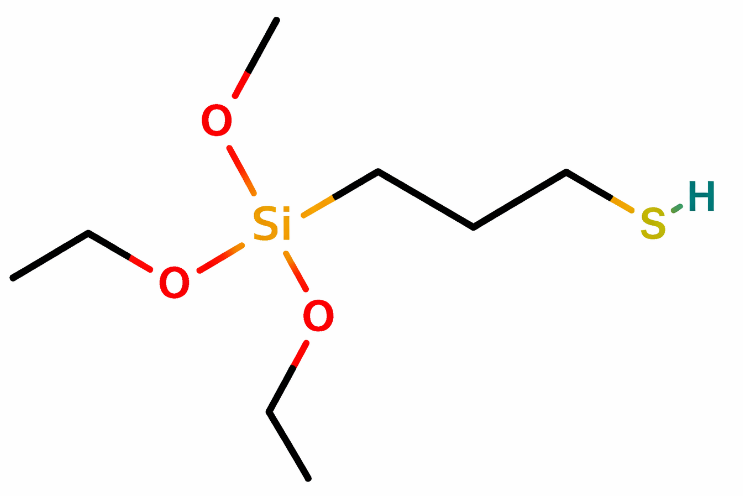
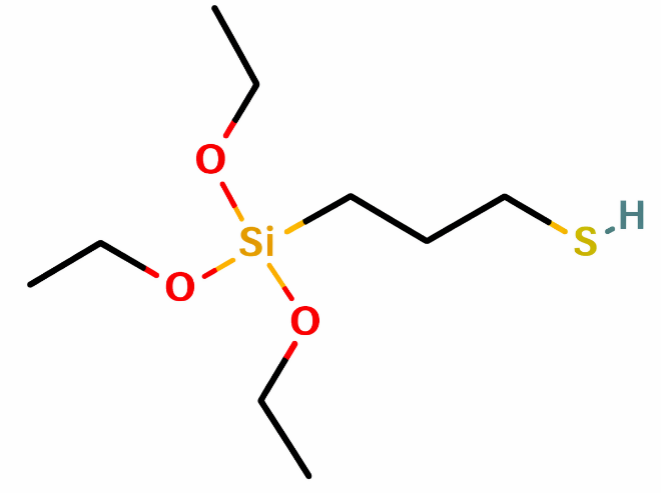
The figure below shows the structural formulas of (3-mercaptopropyl)trimethoxysilane and (3-mercaptopropyl)triethoxysilane. The two compounds have the same mercapto end, and their principal difference lies at the silane end: one is trimethoxy, while the other is triethoxy. Displaying the two structural formulas side by side makes their structural difference easy to visualize directly.
4. Classification of Mercapto Silanes and Representative Products
Category | Structural Feature | Category Characteristics | Representative Product |
Free-mercapto trimethoxy silane | The molecule contains a free mercapto group, and the silane end is trimethoxy | A common free-mercapto trialkoxy silane with relatively fast hydrolysis | (3-Mercaptopropyl)trimethoxysilane |
Free-mercapto triethoxy silane | The molecule contains a free mercapto group, and the silane end is triethoxy | A common free-mercapto trialkoxy silane with relatively slower hydrolysis; formulated systems are usually relatively more stable after incorporation | (3-Mercaptopropyl)triethoxysilane |
Free-mercapto dialkoxy methyl silane | The molecule contains a free mercapto group, and the silane end is a dialkoxy methyl silane structure | It has fewer hydrolyzable sites than trialkoxy silanes. Its hydrolysis and condensation behavior differs from that of trialkoxy silanes, and formulation stability often shows different characteristics | 3-Mercaptopropylmethyldimethoxysilane |
Blocked mercapto silane | The mercapto group is temporarily blocked, while the silane end retains a hydrolyzable structure | It does not directly exist in the form of a free mercapto group. Under suitable conditions, it can be deblocked to regenerate the reactive site of the free mercapto group | 3-Octanoylthio propyltriethoxysilane |
5. Typical Applications, Problems Addressed, and Mechanisms of Action of Mercapto Silanes
Applications of mercapto silanes are mainly concentrated in several scenarios, including interfacial adhesion, filler surface treatment, filler-reinforced elastomers, and surface mercapto functionalization. Their common structural basis is that the molecule contains both a hydrolyzable silane end and a mercapto end: the former is responsible for entering the inorganic interface, while the latter provides reactive sites on the organic side.
Typical Application | Main Problem Addressed | Mechanism of Action |
Adhesives, sealants, and primers | Address insufficient adhesion between glass, metals, and mineral substrates and organic polymers, while improving interfacial performance such as moisture resistance and corrosion resistance | The hydrolyzable silane end first hydrolyzes to form silanols, which then bond with inorganic surfaces such as glass, metals, and fillers. The mercapto end remains on the organic side and can participate in polymer chemical modification or interfacial reactions, thereby linking the inorganic substrate to the organic polymer. |
Adhesion promotion and protection of epoxy resins on metals such as copper and silver | Address poor adhesion of epoxy systems on metals such as copper and silver, as well as insufficient protection at the metal interface | The silane end can form an interfacial layer on metal or metal oxide surfaces, and the mercapto end can participate in related interfacial interactions, thereby improving the adhesion of epoxy systems to metal substrates. In some systems, it may also help improve moisture resistance and protective performance. |
Surface treatment of mineral fillers and pigments | Address poor compatibility between inorganic fillers and resins, insufficient dispersion, and weak interfacial bonding | The silane end bonds with hydroxyl sites on the filler surface to form an organofunctional layer on the inorganic filler surface. The mercapto end is oriented toward the resin side, improving compatibility and interfacial adhesion between the filler and the resin. |
Inorganic filler-reinforced rubber and elastomers | Address insufficient interfacial bonding, deterioration in mechanical properties, poor compression set, and unsatisfactory curing performance after incorporating reinforcing mineral fillers such as silica, clay, mica, and talc into rubber or elastomer systems | Mercapto silanes chemically link reinforcing minerals such as silica, clay, mica, and talc to the polymer matrix, thereby improving properties such as modulus, tensile strength, tear strength, abrasion resistance, rebound, compression set, and cure time. They are especially common in sulfur-cured and metal oxide-cured elastomer systems. |
Surface mercapto functionalization and construction of functional materials | Address the lack of subsequent reactive sites on inorganic or silicone surfaces, and introduce mercapto sites on the surface for further reaction | The silane end is first anchored to the silica or silicone surface, while the mercapto end remains on the outer surface, forming a functionalized surface bearing mercapto groups. This is also the structural basis for its use in the preparation of mercapto organosilica nanoparticles or mercapto-functionalized surfaces. |
6. Precautions When Using Mercapto Silanes
6.1 Maintain moisture protection and sealing throughout the entire process.
Mercapto silanes undergo hydrolysis and property changes upon contact with water or moisture, so they should be used as soon as possible after opening. Any unused portion should be sealed immediately, and the air in the container should, where possible, be displaced with dry nitrogen. Storage conditions should be cool, protected from light, and low in humidity. The original packaging should be retained as much as possible, and repeated repackaging should be minimized.
6.2 Hydrolysis solutions should be freshly prepared and used promptly, rather than applying a fixed standing time.
The stability of a hydrolysis solution is affected by the type and number of alkoxy groups, the type of organofunctional group, concentration, and pH. Different products and different formulations should not be assigned the same standing time. In R&D work, the “usable time after preparation” should be confirmed separately. When necessary, appropriate alcohols may be added to improve solution stability and the wetting of inorganic substrates.
6.3 When used for resin incorporation, grafting, or formulation, humidity must be carefully controlled.
The surface of inorganic fillers is relatively stable after dehydration and condensation are completed, but once the silane is incorporated into a resin or used in grafting, the system becomes more sensitive to humidity. Resin systems containing mercapto silanes should be stored and handled under the lowest practical humidity to avoid premature hydrolysis and condensation before storage or processing.
6.4 After surface treatment, drying and dehydration-condensation should be taken seriously.
After mercapto silanes are used to treat inorganic substrates, it is not enough merely to apply the silane; the subsequent drying and dehydration-condensation steps must also be completed. Otherwise, the interfacial layer is often incomplete. A common practice is short-time drying and dehydration-condensation at about 110 to 120°C, or extending the treatment time at lower temperatures according to the heat resistance of the substrate.
6.5 Methoxy-type and ethoxy-type silanes should not be handled at the same operational pace.
The methoxy silane end generally hydrolyzes faster than the ethoxy silane end. Hydrolysis of methoxy groups releases methanol, while hydrolysis of ethoxy groups releases ethanol. Accordingly, methoxy-type silanes usually require tighter control over the timing of use and exposure after solution preparation, whereas ethoxy-type silanes generally allow a somewhat slower operational pace.
6.6 Ensure adequate ventilation and exposure control.
Mercapto silanes themselves usually have a mercapto odor, and methoxy-type products may also generate methanol during use. In laboratory work and scale-up operations, ventilation, order of addition, container sealing, and personnel exposure control should all be treated as routine requirements.
7. Classification, Features, and Applications of Representative Mercapto Silanes and Sulfur-Containing Reference Silanes
Classification | CAS No. | Aladdin Catalog No. | Name | Specification or Purity | Product Features and Applications |
Free-mercapto trialkoxy silane (ethoxy type) | 14814-09-6 | (3-Mercaptopropyl)triethoxysilane | ≥96%(GC) | A typical free-mercapto triethoxy silane. It may be used for silanization treatment of inorganic surfaces such as silica and layered silicates, and may also serve as a sulfur-containing interfacial additive in adhesive, sealant, and elastomer systems. It is useful for comparing the hydrolysis behavior and interfacial construction behavior of ethoxy-type mercapto silanes. | |
Free-mercapto dialkoxy methyl silane | 31001-77-1 | 3-Mercaptopropyl(dimethoxy)methylsilane | ≥95%(GC) | A dialkoxy methyl mercapto silane suitable for comparing how a reduced number of hydrolyzable sites affects surface treatment, post-hydrolysis stability, and interfacial layer formation. It can also be used as a reference compound in studies on structural differences among mercapto silanes. | |
Free-mercapto trialkoxy silane (methoxy type) | 4420-74-0 | (3-Mercaptopropyl)trimethoxysilane | ≥95% | A typical free-mercapto trimethoxy silane, commonly used for interfacial coupling between mineral fillers such as silica, kaolin, mica, and talc and polymers. It may also be used for adhesion promotion on surfaces such as glass and metal oxide layers, as well as for the construction of mercapto-functionalized surfaces. | |
Blocked mercapto silane (triethoxy type) | 220727-26-4 | S-(OCTANOYL)MERCAPTOPROPYLTRIETHOXYSILANE | ≥97% | A blocked mercapto silane commonly used in systems where it is desirable to reduce free mercapto odor and control reactivity before application. It may also serve as a reference compound for comparing blocked mercapto silanes with free mercapto silanes. | |
Thiocyanato-functional silane (triethoxy type) | 34708-08-2 | Triethoxy(3-thiocyanatopropyl)silane | ≥95% | A thiocyanato-type sulfur-containing functional silane. It may serve as a comparative route distinct from mercapto-type and polysulfide-type silanes, and may be used to compare interfacial coupling and vulcanization behavior in silica-containing filler-rubber systems. | |
Polysulfide sulfur-containing silane (disulfide) | 56706-10-6 | Bis(Triethoxysilylpropyl)Disulfide | ≥98% | A typical disulfide silane commonly used for coupling between fillers and polymers in silica-filled rubber. It may also serve as a sulfur-containing coupling agent for comparison with mercapto-type silanes, allowing comparison of interfacial action and vulcanization behavior among different sulfur-containing structures. | |
Polysulfide sulfur-containing silane (tetrasulfide) | 40372-72-3 | Bis[3-(triethoxysilyl)propyl] tetrasulfide(TESPTS) | ≥90% | A typical tetrasulfide silane commonly used for filler coupling and reinforcement in silica-filled rubber and tire formulations. It may also serve as an important reference compound for comparison with blocked mercapto silanes and free mercapto silanes, allowing comparison of interfacial action and vulcanization behavior among different sulfur-containing structures. |
Table 2 | Typical Inorganic Fillers and Metal Interface Reference Materials in Mercapto Silane Research
Classification | CAS No. | Aladdin Catalog No. | Name | Specification or Purity | Product Features and Applications |
Typical aluminosilicate mineral filler | 1332-58-7 | K299133 | Kaolin | Filler grade, kaolinite content ≥80% | A common layered aluminosilicate filler that may be used to evaluate the treatment effect of mercapto silanes on the surfaces of platy mineral fillers, filler dispersion state, and polymer interfacial bonding. |
Typical layered silicate mineral filler | 12001-26-2 | Phlogopite | Industrial grade, 200 mesh | A platy mineral filler suitable for studying the silanization treatment of mica surfaces by mercapto silanes, interfacial wetting, and the reinforcing behavior of layered fillers in composites. | |
Typical acid-activated layered silicate material | 1318-93-0 | M758183 | Montmorillonite K-10 | Powder | An acid-activated montmorillonite material suitable for research on layered silicate modification and surface treatment. It may be used to examine grafting of mercapto silanes onto high-surface-area clay materials, adjustment of interfacial polarity, and dispersion behavior in composite filler systems. |
Typical siliceous inorganic filler | 7631-86-9 | Silicon dioxide | AR, ≥99% | A commonly used inorganic surface reference material in mercapto silane research. It may be used in studies of surface hydroxyl reactions, filler coupling, adhesion promotion in adhesives, and reinforcement systems for rubber. | |
Typical layered silicate mineral filler | 14807-96-6 | T109494 | Talc | 800 mesh | A common platy mineral filler that may be used to investigate the treatment effect of mercapto silanes on talc surfaces, as well as interfacial improvement of fillers in resin, rubber, and sealant systems. |
Typical metal interface reference material | 7440-22-4 | Silver | ≥99.9% metals basis, powder, 2-3.5 μm | May serve as a representative metal material in studies on metal adhesion and surface interactions of mercapto-type silanes, and may be used to compare interfacial interactions between the mercapto end and silver surfaces, as well as functional layer construction. | |
Typical metal interface reference material | 7440-50-8 | Copper | ≥99%, powder, <75 μm | Commonly used in research on metal adhesion promotion by mercapto silanes, and may serve as a representative material for studies on adhesion improvement at copper interfaces with epoxy resins or other organic systems, surface treatment, and metal powder composite materials. |
Note: The above are representative Aladdin products. For more product specifications, search by “product name/CAS/catalog number” on the Aladdin website.
References
[1] Shin-Etsu Silicone. Silane Coupling Agents.
[2] Shin-Etsu Silicones of America, Inc. KBM-803.
[3] Evonik Operations GmbH. Dynasylan® MTMO Technical Data Sheet.
[4] Momentive Performance Materials Inc. Silquest™ A-189 Technical Data Sheet.
[5] Momentive Performance Materials Inc. Silquest™ A-Link™ 599 Technical Data Sheet.
[6] Gelest, Inc. Silane Coupling Agents.
[7] Plueddemann EP. Silane Coupling Agents. 2nd ed. New York: Springer; 1991.
For more related articles, please see below: