
Pyrimidine Research Selection Guide: Structural Features, Typical Applications, and a Reagent/Building-Block Classification Navigator (Tables 1–5)
Pyrimidine Research Selection Guide: Structural Features, Typical Applications, and a Reagent/Building-Block Classification Navigator (Tables 1–5)
1.Why does pyrimidine appear so frequently in life sciences and chemical research?
If we think of DNA/RNA as a “chemical book” that encodes the information of life, then the pyrimidine family constitutes half of its “letters”: cytosine (C), thymine (T, in DNA), and uracil (U, in RNA) are all pyrimidine bases. Pyrimidines are therefore intrinsically tied to genetic information, replication and transcription, mutation, and repair.
In chemistry and drug discovery, pyrimidine is also a very high-frequency heteroaromatic core. It can provide hydrogen-bond acceptors, tune molecular polarity and metabolic stability, and rapidly reshape biological activity profiles through different substitution patterns. For these reasons, it is often used as a “general-purpose scaffold” in lead optimization.
2.Definition and structure of pyrimidine
Pyrimidine is a six-membered aromatic heterocycle with two ring nitrogens located at the 1 and 3 positions, and is therefore also referred to as 1,3-diazine (1,3-diazabenzene).
1. Molecular formula: C₄H₄N₂ (the pyrimidine parent ring)
2. In DNA/RNA discussions: In the literature, “pyrimidine” often refers to the pyrimidine nucleobase family—cytosine (C), thymine (T, DNA), and uracil (U, RNA), among others. These are monocyclic nitrogen-containing heterocycles that serve as nucleobases (nitrogenous bases). Here, “base” is a historical naming convention and does not necessarily mean that the compound is strongly basic in aqueous solution.
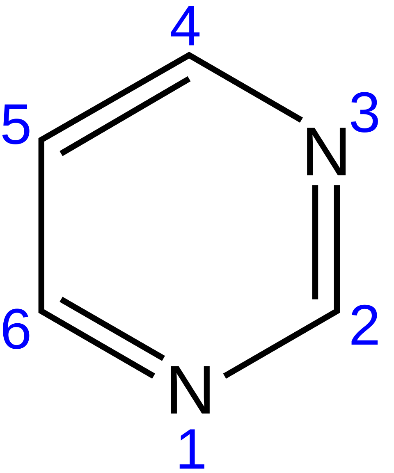
Quick comparison: distinguishing the three diazines (pyridazine / pyrimidine / pyrazine)
Name | Positions of N (numbering) | Common alias/notes | One-line identifier |
Pyridazine | 1,2-Diazine | ortho-diazine | Two N atoms adjacent (1,2) |
Pyrimidine | 1,3-Diazine | meta-diazine; 1,3-diazabenzene | Two N atoms separated by one carbon (1,3) |
Pyrazine | 1,4-Diazine | para-diazine | Two N atoms opposite each other (1,4) |
3.Structural features: what “predictable properties” arise from the two nitrogens (1,3-positions)?
The key to pyrimidine lies in “aromaticity + the electronic effects of two ring nitrogens.”
3.1 Electron-deficient character: electrophilic substrate behavior in SNAr and cross-coupling
1. Because of the electron-withdrawing effects of the two ring nitrogens, pyrimidine overall shows a stronger electron-deficient character. For synthetic planning, the most direct implication is: when the pyrimidine ring bears a leaving group such as a halogen (especially F, Cl at the 2/4/6 positions), it often undergoes nucleophilic aromatic substitution (SNAr) more readily. Under basic conditions, this enables rapid installation of fragments such as amines, alcohols (alkoxy groups), or thiols (thioethers), thereby efficiently constructing substituted pyrimidine frameworks.
2. In addition, when sulfonate esters such as OTf (triflate) are introduced, they more commonly serve as electrophilic “handles” for cross-coupling (e.g., Suzuki, Buchwald–Hartwig, etc.). Together with halogenated sites, they provide complementary options that facilitate modular assembly and position-by-position scanning.
3.2 Much weaker basicity: a clear difference compared with pyridine
1. Due to the electron-withdrawing effects of the two ring nitrogens, pyrimidine is significantly less basic than pyridine. In aqueous solution (room temperature, under typical ionic-strength conditions), reported values for the pKaH of the conjugate acid of pyrimidine commonly fall around 1.2–1.3, whereas the pKaH of pyridinium (the conjugate acid of pyridine) is commonly around 5.2. Therefore, under the same conditions, pyrimidine is harder to protonate, and its ionizability and tendency to form salts are typically much lower than those of pyridine.
2. It is important to note that pKa depends on conditions such as solvent, temperature, and ionic strength. The values above are best used as an order-of-magnitude comparison. In addition, in strongly acidic environments pyrimidine may undergo a second protonation, but this requires much harsher acidity and the corresponding pKa is usually much lower (often on the order of negative values). It is generally not a primary focus in discussions under routine aqueous or physiological conditions.
3. This weaker basicity further influences salt formation, the fraction ionized at physiological pH, solubility and membrane permeability, and also affects how pyrimidine engages in hydrogen-bonding and electrostatic interactions with protein targets.
4.Why is pyrimidine so common in drugs and functional molecules?
The core reason is that it simultaneously satisfies three requirements:
1. Regular geometry and predictable substitution sites: The six-membered aromatic ring makes it convenient to perform systematic SAR (structure–activity relationship) exploration at positions such as C2/C4/C5/C6.
2. A rich “interaction language”: Ring nitrogens provide stable hydrogen-bond acceptor capability, supporting directional interactions with protein binding sites.
3. Strong synthetic generality: Its electron-deficient character makes it robust in strategies such as SNAr and cross-coupling, well-suited for modular assembly.
5.Are pyrimidine-related products important? Why are they important?
Their importance usually comes from two major research-demand chains:
1. Life-science chain (nucleic-acid related): Pyrimidine bases and their nucleoside/nucleotide derivatives are used in molecular biology, metabolism research, labeling and tracing, method development, and quantitative analysis with standards. IUPAC also lists “pyrimidines and their natural substituents (pyrimidine bases)” as a standalone important term.
2. Synthesis & medicinal-chemistry chain (building-block related): A large number of drugs and agrochemicals contain pyrimidine / fused-pyrimidine motifs. For example, the 2,4-diaminopyrimidine (DAP) scaffold is the shared core of classic DHFR inhibitor families (e.g., trimethoprim).
6.A practical classification framework for pyrimidine-related products
Major category (entry point for selection) | What you are typically doing | Typical product forms (examples) | Key reason to choose it |
Parent ring / simple substituted derivatives | Build basic references; run solvent/reaction screening | Pyrimidine; methyl/hydroxy/amino-substituted pyrimidines | Serves as a “starting scaffold” to establish baseline reactivity and properties |
Electrophilic building blocks (SNAr / coupling substrates) | Rapidly install fragments; perform position scanning | 2-/4-/5-/6-halopyrimidines; polyhalopyrimidines | Electron-deficient ring + leaving group enables SNAr or cross-coupling to expand the scaffold |
Nucleophilic building blocks (to connect onto other scaffolds) | Use an amine/alcohol/thiol terminus to link | Aminopyrimidines, hydroxypyrimidines, thiopyrimidines, etc. | Provides a connection point while retaining pyrimidine recognition features |
Coupling partner reagents | Assemble via Suzuki and related couplings | Pyrimidyl boronic acids/boronate esters (or equivalent organometallics) | Complements halopyrimidines and supports modular construction |
Functional-group platforms (for downstream transformations) | Amide coupling, reduction, oxidation, salt formation, etc. | Carboxylic acid/ester, nitrile, aldehyde, sulfonyl-substituted pyrimidines | Facilitates introduction of polarity and 3D fragments; improves ADME |
Nucleic-acid / biochemical related (“pyrimidine base family”) | DNA/RNA, metabolism, quantitative analysis | U/T/C and their nucleosides/nucleotides; isotope-labeled compounds | Directly tied to genetic information and metabolic networks |
Drugs/agrochemicals and standards | Method validation, reference standards, mechanistic studies | DAP-class DHFR inhibitor related; pyrimidine-class agrochemicals | Directly bound to real application scenarios (efficacy/toxicology/residue analysis) |
7.Typical applications: how does pyrimidine span multiple research and application domains?
7.1 Nucleic acids and molecular biology
Pyrimidine bases (C/T/U) form the basic information units of DNA/RNA and constitute foundational “vocabulary” for nucleic-acid synthesis, sequencing, mutagenesis studies, and DNA/RNA repair mechanism research.
7.2 Anti-infectives and metabolic-pathway targets (DHFR inhibitors as a representative example)
The 2,4-diaminopyrimidine scaffold is a classic motif in DHFR inhibitors (e.g., trimethoprim) and is widely used for mechanism research and lead optimization in antibacterial and antiparasitic programs.
7.3 Agricultural chemistry (pyrimidine fungicides, etc.)
Anilinopyrimidines are an important fungicide chemical class, commonly appearing in research on gray mold and related disease control, as well as in residue-analysis method development.
7.4 Fused-pyrimidine expansion in medicinal chemistry: quinazoline as a representative example
Quinazoline can be understood as a scaffold formed by fusion of a benzene ring with a pyrimidine ring. It is very common in medicinal chemistry, especially frequent in areas such as kinase inhibitors.
8.Product navigation table|Select the right table quickly by research task: pyrimidine-related reagents/standards/building blocks (with scenario tags and selection logic; corresponding to Tables 1–5)
Research task / experimental need | Selection logic | Key structural/property cues (how to locate in the table) | Recommended table to check first | What you can find in the table |
[Fundamentals / metabolic pathways] First clarify the “pyrimidine family” concepts and pathway nodes: which standards are needed for the parent ring / bases / de novo synthesis pathway? | The core is “definition and pathway positioning.” You need bottom-layer reference points—parent ring, the three major bases, and synthesis intermediates—rather than nucleosides/drugs/building blocks. | Parent ring (pyrimidine); bases (U/T/C); de novo intermediates (orotic acid, L-dihydroorotic acid); epigenetic bases (5mC/5hmC) | Table 1: Parent ring / bases / metabolic intermediates / epigenetic-base standards | Pathway-node standards and foundational references: “positioning tools” for metabolomics/enzymatic substrates and for pathway block/rescue design |
[Cell culture / supplementation & rescue] Supplement pyrimidine precursors in cell culture; study salvage/nucleoside transport; or supply DNA/RNA nucleosides | Cell-level “supplementation/rescue/transport” mainly uses nucleosides and deoxynucleosides (enter cells more readily and are phosphorylated). So start with the nucleoside-level consolidated table. | Cytidine/uridine/thymidine; 2′-deoxyuridine/2′-deoxycytidine, etc.; focus on cell-culture grade/high purity | Table 2: Nucleosides / deoxynucleosides (incl. labeled/modified/epigenetic nucleoside standards) | Common supplementation nucleosides and deoxynucleosides: for salvage validation, nucleoside transport, and nucleotide-pool intervention |
[Cell proliferation / replication assays] Measure proliferation/replication: S-phase cells, DNA replication rate, proliferation imaging/flow cytometry | The key is “detectable nucleosides that can be incorporated into DNA,” which are concentrated in the nucleoside/deoxynucleoside table (e.g., BrdU/EdU). | BrdU (antibody-based detection); EdU (click chemistry); halogenated dU (iodo/chloro-dU) as alternatives/controls | Table 2 | DNA synthesis labeling nucleosides: for proliferation assessment, replication dynamics, and high-throughput imaging/flow |
[Transcription / nascent RNA tracking] Track nascent RNA/transcription kinetics: transcription activity, RNA turnover, pulse-chase (imaging/enrichment/sequencing workflows) | Transcription tracking requires “labeled uridines that can be incorporated into RNA,” still at the nucleoside level (5-EU, 4sU). So prioritize Table 2. | 5-EU (click chemistry); 4sU (pulse labeling/turnover); whether downstream enrichment/detection is needed | Table 2 | Nascent-RNA labeling and tracking nucleosides: for transcription rate, RNA half-life changes, and stress-response studies |
[PCR / library prep for sequencing] PCR/qPCR/sequencing library prep/in vitro replication: need high-purity dNTPs; or dUTP for anti-contamination | This is essentially “enzyme substrates.” You need molecular-biology-grade dNTP/dUTP, concentrated in the nucleotide/dNTP table. | UltraPure dCTP, UltraPure dTTP (100 mM); dUTP (+UNG for carryover prevention) | Table 3: Nucleotides / dNTPs / UDP-sugar donors | Ready-to-use dNTP/dUTP for amplification: ensures efficiency and lowers nuclease/contamination risk |
[Metabolomics / enzymology substrates] Study nucleotide pools or pathway enzymes: use NMP/dNMP/UDP/OMP as substrates or quantitative standards | You need nucleotide-level molecules as substrates/standards (NMP, dNMP, UDP, OMP), so start with Table 3 (not nucleosides or drugs). | UMP/CMP; dCMP/dTMP/dUMP; UDP; OMP (orotidine 5′-monophosphate) | Table 3 | Nucleotide substrates and pathway nodes: suitable for kinases/synthases, flux analysis, and quantitative calibration |
[Glycobiology / glycosylation] Glycobiology: glycosyltransferases, glycan synthesis, O-GlcNAc, reconstructing sialylation systems | The “energy donors” are UDP-sugars and CMP-sialic acid, concentrated in Table 3. Start there, then choose donors by the transferase. | UDP-glucose, UDP-galactose, UDP-GlcNAc; CMP-sialic acid | Table 3 | Activated sugar donors and CMP-Sia: for in vitro glycosylation, donor specificity, and kinetic measurements |
[Epigenetics / methylation] Epigenetics: demethylation intervention + quantification/method validation for 5mC/5hmC | Often two steps: pharmacologic intervention (DNMT inhibitors) → quantitative verification (5mC/5hmC standards). So prioritize Table 4 for intervention, then use Table 1/2 to “measure accurately.” | Intervention: 5-azacytidine, 5-aza-dC; quantitative controls: 5mC/5hmC (bases), 5m-dC/5hm-dC (nucleosides) | Table 4 + Table 1/Table 2 (start with Table 4) | Table 4 provides tools to change methylation; Table 1/2 provide standards to calibrate and validate detection |
[Drug mechanism / screening controls] Anticancer/anti-infective/antiviral mechanism studies: efficacy controls, resistance mechanisms, combination therapy | You need bioactive molecules and classic reference drugs, concentrated in the drug table (Table 4). Nucleosides/nucleotides are more for rescue or mechanistic extensions. | Anticancer (5-FU/FUDR/capecitabine/gemcitabine/Ara-C/trifluridine); antifungal (5-FC); antiviral (AZT/d4T/3TC/FTC/brivudine) | Table 4: Bioactivity/application-oriented (drugs/reference standards/mechanistic tools) | A set of representative pyrimidine drugs and mechanism tools: quickly establish control systems and validation paths |
[Synthetic library / med-chem optimization] Med-chem or library synthesis: build substituted pyrimidines via SNAr/coupling; optimization and derivatization platforms | The key is “reactive handles and electrophilic platforms”: chloro/poly-chloro for SNAr, 5-halo for coupling, amino/thio for functionalization entry points—concentrated in the building-block table (Table 5). | 2-/4-/poly-chloropyrimidines (SNAr); 5-bromo/5-iodopyrimidines (coupling handles); 2-/4-amino, 2-mercapto, 2-thiourea pyrimidines (functionalization) | Table 5: Synthetic building blocks (halo/amino/thio pyrimidines) | Rapid construction of substituted pyrimidine scaffolds and compound libraries: suited for parallel synthesis and lead optimization |
Table 1 | Parent Ring / Bases / Metabolic Intermediates / Epigenetic “Base” Standards
Category | CAS No. | Aladdin Cat. No. | Name | Spec / Purity | Key features & applications |
Pyrimidine parent ring / basic scaffold (solvent/reaction medium/scaffold reference) | 289-95-2 | Pyrimidine | ≥99% | The most fundamental 1,3-diazine (electron-deficient heteroaromatic) parent ring; used for teaching and structural benchmarking, heteroaromatic property studies, and commonly as a “parent-ring reference” for pyrimidine-containing drug scaffolds. | |
Natural pyrimidine base (cell culture/metabolism) | 66-22-8 | Uracil | Moligand™, for cell culture, ≥99% | One of the RNA bases; widely used in de novo/salvage pyrimidine-pathway studies, as a rescue control in nucleotide-synthesis inhibitor experiments, and as a metabolomics standard. | |
Natural pyrimidine base (cell culture/metabolism) | 65-71-4 | Thymine | Moligand™, for cell culture, ≥99% | A DNA-specific base; commonly used in pyrimidine-base salvage (base → nucleotide) research, microbial auxotrophy supplementation, and foundational nucleic-acid metabolism experiments. | |
Natural pyrimidine base (fundamentals/metabolism) | 71-30-7 | Cytosine | Moligand™, ≥98% | One of the nucleic-acid bases; used in basic studies of base salvage and nucleotide metabolism, as an enzymatic substrate/standard, and in nucleic-acid chemistry and base-pairing property research. | |
De novo pyrimidine biosynthesis intermediate (metabolism research) | 65-86-1 | Orotic acid | Moligand™, ≥98% | A key intermediate in de novo pyrimidine biosynthesis (orotate); used in studies of UMP biosynthesis enzymes (e.g., the UMPS pathway), in metabolic supplementation/blockade experimental design, and as a metabolomics standard. | |
De novo pyrimidine biosynthesis intermediate (DHODH node) | 5988-19-2 | L-Dihydroorotic acid | ≥98% | Located at the critical “dihydroorotate ↔ orotate” node; used for de novo pyrimidine-pathway studies, DHODH-related reaction/inhibitor evaluation systems, and metabolic supplementation/blockade experiments. | |
Base analog / mutagenesis tool | 51-20-7 | B109680-MGI | 5-Bromouracil | ≥99%, light yellow | A classic uracil base analog; can promote mispairing, serving as a model compound for studies of mutagenesis mechanisms, base tautomerism, and DNA mismatch repair. |
Epigenetic modified-base standard (5mC) | 554-01-8 | 5-Methylcytosine | ≥98% | A hallmark modified base of DNA methylation; used for 5mC method development and validation (LC–MS/antibody/chemical labeling), methylation-level controls, and mechanistic studies. | |
Epigenetic modified-base standard (5hmC) | 1123-95-1 | 5-(Hydroxymethyl)cytosine (5hmC) | Moligand™, ≥95% | A key epigenetic modified base in DNA; used for 5hmC quantification and method development (LC–MS, antibody/chemical-labeling validation), TET-related reaction studies, and controls for sequencing-based detection workflows. |
Table 2 | Nucleosides / Deoxynucleosides (including click labels, halogenated incorporation, RNA modifications, and epigenetic “nucleoside” standards)
Category | CAS No. | Aladdin Cat. No. | Name | Spec / Purity | Key features & applications |
Natural pyrimidine nucleoside (cell culture/metabolic supplementation) | 65-46-3 | Cytidine | For cell culture; endotoxin <500 EU/g; microbial limit ≤100 cfu/g | A classic pyrimidine nucleoside; commonly used for cell-culture supplementation and salvage-pathway studies, to modulate CTP/CDP nucleotide pools, and to support experiments related to RNA and membrane-phospholipid precursor metabolism. | |
Natural pyrimidine nucleoside (cell culture/metabolic supplementation) | 58-96-8 | Uridine | For cell culture, ≥99% | The most commonly used pyrimidine nucleoside supplement in cells; widely used in nucleoside transport/salvage studies and as an “exogenous rescue” control for cellular pyrimidine supply under de novo inhibition. | |
Natural pyrimidine deoxynucleoside (DNA-related/metabolic supplementation) | 951-78-0 | 2'-Deoxyuridine | PharmPure™, Ph. Eur.; endotoxin <50 EU/g; microbial limit ≤100 cfu/g | A DNA-related pyrimidine deoxynucleoside; used in nucleoside metabolism and nucleotide-pool studies, salvage-pathway supplementation, and metabolic intervention experiments related to dTMP/dTTP balance. | |
Natural pyrimidine deoxynucleoside (DNA-related/cell culture) | 50-89-5 | Thymidine | PharmPure™, USP; endotoxin <50 EU/g; microbial limit ≤100 cfu/g | One of the core precursors for DNA synthesis; commonly used for cell-cycle synchronization (thymidine block), DNA replication studies, and as a control in pyrimidine nucleoside metabolism/salvage experiments. | |
Natural pyrimidine deoxynucleoside (DNA-related/metabolic supplementation) | 951-77-9 | 2′-Deoxycytidine | ≥99% | dC is a building block of DNA; used for nucleoside transport/salvage studies, nucleotide-pool supplementation, and establishing replication-stress models related to dCTP supply. | |
Epigenetic modified-nucleoside standard (5mC) | 838-07-3 | 2'-Deoxy-5-methylcytidine | ≥99% | A deoxynucleoside standard for the core DNA methylation modification (5mC); used for methylation quantification (LC–MS), validation of antibody/enzymatic assays, and as controls in methylation/demethylation pathway studies. | |
Epigenetic modified-nucleoside standard (5hm-dC) | 7226-77-9 | 5-(Hydroxymethyl)-2'-deoxycytidine | ≥95% | The deoxynucleoside-form standard of 5hmC; used for LC–MS quantification of 5hmC and related modifications, method validation, and calibration/controls in TET-pathway studies. | |
DNA replication label (nucleic-acid synthesis tracing) | 59-14-3 | 5-Bromo-2′-deoxyuridine (BrdU) | UltraBio™, ≥99% | A classic thymidine analog for DNA incorporation; used for S-phase cell detection, DNA replication/proliferation tracing, immunostaining (anti-BrdU), and cell-cycle studies. | |
DNA replication label (click chemistry; EdU) | 61135-33-9 | 5-Ethynyl-2'-deoxyuridine (EdU) | ≥98% | A classic click-chemistry DNA-synthesis labeling nucleoside; often used as an alternative to BrdU-based immunodetection for proliferation/replication kinetics studies and high-throughput imaging. | |
RNA metabolic label (click chemistry; nascent RNA tracing) | 69075-42-9 | 5-Ethynyluridine (5-EU) | ≥99% | Ethynyluridine can be incorporated into nascent RNA and subsequently visualized/enriched via click chemistry; used for transcription-activity measurements, RNA synthesis-rate studies, and transcriptional changes under cellular stress. | |
RNA metabolic label (transcription tracing) | 13957-31-8 | 4-Thiouridine (4sU) | Moligand™, ≥98% | A widely used “nascent RNA” metabolic labeling nucleoside; supports pulse labeling, transcription kinetics, and RNA turnover studies (e.g., concepts underlying 4sU-seq/SLAM-seq). | |
DNA replication label / halogenated deoxynucleoside (incorporation tracing) | 54-42-2 | 5-Iodo-2′-deoxyuridine | ≥99% | Halogenated dU analogs can be incorporated into DNA; used for DNA replication tracing, nucleic-acid metabolism studies, and comparative incorporation-efficiency experiments versus other nucleoside analogs. | |
DNA replication label / halogenated deoxynucleoside | 50-90-8 | 5-Chloro-2'-deoxyuridine | ≥98% | Halogenated dU analogs can be incorporated into DNA; used for replication tracing, incorporation controls among nucleoside analogs, and mechanistic studies related to DNA metabolism. | |
RNA modified nucleoside (Ψ; structure/function studies) | 1445-07-4 | Pseudouridine | ≥98% | The most common natural RNA modification; used for RNA-modification quantification and method validation, studies of pseudouridylation enzymes (PUS), and experiments on how modifications affect RNA structure/translation. | |
RNA modified nucleoside (mRNA research / in vitro transcription) | 13860-38-3 | N1-Methylpseudouridine | ≥98% | An important mRNA-modified nucleoside; commonly used in in vitro transcription (IVT) to produce modified RNA with improved stability and translation efficiency and reduced innate immune activation, for mRNA/vaccine and delivery research. | |
Protected nucleoside / synthetic intermediate (sugar hydroxyl protection) | 4105-38-8 | 2′,3′,5′-Tri-O-acetyluridine | ≥99% | A commonly used protected uridine derivative; used in nucleoside chemistry and oligonucleotide/nucleoside-analog synthesis via “sugar protection → selective functionalization” strategies to improve selectivity and controllability. |
Table 3 | Nucleotides / dNTPs / UDP-sugar donors (commonly used in molecular biology, metabolism, and glycobiology)
Category | CAS No. | Aladdin Cat. No. | Name | Spec / Purity | Key features & applications |
Nucleotide (metabolism/enzymology/synthetic precursor) | 58-97-9 | Uridine 5′-monophosphate | Moligand™, ≥98% | A central node in pyrimidine nucleotides; used in de novo pyrimidine synthesis (orotate → UMP) pathway studies, as enzymatic substrates/standards, and for nucleotide-pool supplementation and quantitative metabolomics. | |
Nucleotide (NMP; enzymology/metabolic standard) | 63-37-6 | Cytidine 5′-monophosphate | ≥99% | CMP is a core pyrimidine nucleotide; used in nucleotide metabolism and energy-coupled reaction studies, as enzymatic substrates/standards, and in experiments related to CDP-derivative biosynthesis. | |
Deoxynucleotide (dNMP; enzymology/metabolic standard) | 1032-65-1 | 2′-Deoxycytidine 5′-monophosphate | ≥99% | dCMP is a key node in DNA synthesis and nucleotide metabolism; used as enzymatic substrates for nucleotide kinases/polymerases, in nucleotide-pool analysis, and as a quantitative metabolomics standard. | |
Deoxynucleotide (dNMP; TS pathway/metabolic standard) | 33430-62-5 | Thymidine 5′-monophosphate disodium salt hydrate | ≥99% | dTMP is central to the thymidylate pathway “dUMP → dTMP → dTTP”; used in thymidylate synthesis/salvage studies, TS (thymidylate synthase) intervention experiment design, and as a standard. | |
Deoxynucleotide (dNMP; TS/repair pathway related) | 42155-08-8 | 2′-Deoxyuridine 5′-mono-phos-phate disodium salt | ≥98% | dUMP is a key substrate in the thymidylate pathway (TS substrate) and linked to dUTP/dTTP balance; used in enzymology (TS, dUTPase) and pyrimidine-metabolism intervention experiments. | |
Nucleotide (signaling/enzymatic substrate) | 58-98-0 | UDP | Moligand™ | A pyrimidine diphosphate nucleotide; used in UDP-dependent enzymatic reactions and metabolic-pathway studies, and in vitro validation assays for UDP-related receptors/pathways. | |
UDP-sugar donor (glycosyl transfer/metabolic enzymology) | 133-89-1 | UDP-glucose (UDP-G) | Moligand™, ≥95% | A classic “activated sugar” donor; used in glycosyltransferase reactions, glycogen/polysaccharide pathways, glycosylation studies, and enzymology (substrates, standards, kinetics). | |
UDP-sugar donor (glycosyl transfer/sugar metabolism) | 28053-08-9 | UDP-G | ≥98% | A classic “activated sugar” donor; used in glycosyltransferase reactions, glycogen/polysaccharide and glycosylation pathway studies, and as a common substrate/standard in glycobiology and enzymatic kinetics. | |
UDP-sugar donor (amino-sugar donor; glycobiology) | 91183-98-1 | Uridine 5′-Diphospho-N-acetylglucosamine Disodium Salt | ≥98% | UDP-GlcNAc is a key donor for protein/glycan synthesis; used in glycosyltransferase studies (including N-glycosylation-related), O-GlcNAc pathway research, glycomics methods, and enzymatic substrate work. | |
UDP-sugar donor (galactose donor; glycosyl transfer) | 137868-52-1 | UDP-ALPHA-D-GALACTOSE DISODIUM SALT | ≥95% | A typical galactose donor; used in galactosyltransferase reactions, glycan synthesis and glycomics research, and donor-specificity/kinetic parameter measurements. | |
De novo pyrimidine biosynthesis intermediate (OMP node) | 68244-58-6 | Orotidine 5′-monophosphate trisodium | ≥99% | OMP (orotate nucleotide) is a key node in de novo synthesis (OMP → UMP); used for UMPS-related reactions, pyrimidine-synthesis deficiency models, and metabolic-pathway validation. | |
CMP–sialic acid donor (sialylation; glycobiology) | 3063-71-6 | CMP-Sialic Acid, Monosodium Salt | ≥85% | A classic donor for sialylation reactions; used in sialyltransferase enzymology, constructing terminal modifications on glycoproteins/glycolipids, glycan-function studies, and in vitro reconstruction experiments. | |
Cell metabolism / neuroscience related nucleotide derivative (CDP-choline) | 33818-15-4 | Citicoline sodium salt hydrate | ≥98% | CDP-choline is a key intermediate in phospholipid (phosphatidylcholine) biosynthesis; used in membrane-lipid metabolism, neuronal cell function and metabolic supplementation studies, and as a reference in related enzymology/metabolomics. | |
dNTP (PCR / molecular-biology grade) | 102783-51-7 | UltraPure dCTP (100mM) | BioReagent; DNase/RNase-free; PCR reagent; endotoxin-tested; UltraBio™; molecular biology grade; sterile; for DNA and RNA applications; ≥99%; 100 mM | An essential substrate for PCR/sequencing/in vitro transcription systems; high purity and nuclease-free, suitable for amplification, cloning, and enzymatic reactions where background contamination must be minimized. | |
dNTP (PCR / molecular-biology grade) | 18423-43-3 | UltraPure dTTP (100mM) | BioReagent; DNase/RNase-free; PCR reagent; endotoxin-tested; UltraBio™; molecular biology grade; sterile; for DNA and RNA applications; ≥99%; 100 mM | A key raw material for DNA synthesis and amplification; used in PCR/qPCR/library prep/enzymatic reactions to ensure high efficiency and low background, suitable for stringent molecular biology applications. | |
dUTP (PCR / contamination control / labeling) | 102814-08-4 | dUTP (100mM) | BioReagent; DNase/RNase-free; PCR reagent; molecular biology grade; sterile; for DNA and RNA applications; ≥99%; 100 mM | Commonly used in PCR anti-contamination strategies via “dUTP + UNG” (carryover removal); also used for DNA synthesis requiring U incorporation, enzymology studies, and specific labeling/probe designs. |
Table 4 | Bioactivity / Application-Oriented (Drugs, Reference Standards, and Key Mechanistic Tools)
Category | CAS No. | Aladdin Cat. No. | Name | Spec / Purity | Key features & applications |
Epigenetic modulator (DNMT inhibitor) | 320-67-2 | 5-Azacytidine | γ-irradiated, BioReagent, suitable for hybridoma, lyophilized powder | A cytidine analog that can be incorporated into RNA/DNA and inhibits DNA methyltransferases (DNMTs); widely used for demethylation and gene reactivation experiments, cancer epigenetics research, and validation of phenotype restoration in cells. | |
Epigenetic modulator (DNMT inhibitor) | 2353-33-5 | 5-Aza-2′-deoxycytidine | Moligand™, ≥98% | A commonly used demethylation agent (DNMT inhibitor); preferentially incorporated into DNA to induce hypomethylation, often used to reduce DNA methylation, re-express tumor suppressor genes, and validate epigenetic mechanisms. | |
Antitumor pyrimidine antimetabolite (5-FU pathway) | 51-21-8 | Fluorouracil | PharmPure™, USP | A classic pyrimidine antimetabolite; inhibits thymidylate synthesis and can be incorporated into RNA/DNA; commonly used for tumor-cell sensitivity assessment, pyrimidine-pathway perturbation, and chemotherapy mechanism studies. | |
Antitumor pyrimidine antimetabolite (dU analog / TS inhibition) | 50-91-9 | 5-Fluoro-2′-deoxyuridine (FUDR) | Moligand™, ≥99% | The deoxynucleoside form of 5-FU; strongly perturbs dTMP synthesis (TS pathway); used for DNA synthesis inhibition studies, thymidine-rescue experiment design, and mechanisms of proliferation inhibition/cell death. | |
Antitumor pyrimidine antimetabolite (5-FU prodrug) | 154361-50-9 | Capecitabine | Moligand™, ≥99% | A representative oral 5-FU prodrug; used for studies of metabolic activation, prodrug–active metabolite linkage validation, and efficacy differences/combination strategies within the 5-FU pathway. | |
Antitumor pyrimidine antimetabolite (5-FU prodrug) | 17902-23-7 | FT-207 (NSC 148958) | Moligand™, ≥98% (HPLC) | A tegafur-class 5-FU prodrug; used as a control/validation tool for prodrug activation, pharmacokinetics-related experiments, and 5-FU pathway mechanism/resistance studies. | |
Antitumor pyrimidine nucleoside analog (DNA synthesis inhibition) | 95058-81-4 | Gemcitabine | Moligand™, ≥99% | A deoxycytidine analog; inhibits DNA synthesis and affects nucleotide metabolism (including RNR-related effects); commonly used for cytotoxicity evaluation and pyrimidine-metabolism perturbation experiments. | |
Antitumor pyrimidine nucleoside analog (DNA polymerase inhibition) | 147-94-4 | Cytosine β-D-arabinofuranoside | Moligand™, ≥98% | A classic anti-leukemia drug (Ara-C); inhibits replication primarily via DNA incorporation; used for DNA polymerase mechanism studies, cytotoxicity evaluation, and comparative efficacy studies among nucleoside analogs. | |
Antitumor pyrimidine nucleoside analog (DNA incorporation) | 70-00-8 | Trifluridine | Moligand™, ≥98% | A thymidine analog that can be incorporated into DNA to interfere with replication; used for studies on proliferation inhibition, DNA-incorporation detection, and comparisons across nucleoside analogs. | |
Anti-infective pyrimidine analog (antifungal / microbiology) | 2022-85-7 | 5-Fluorocytosine | Moligand™, ≥99% | A classic antifungal drug (converted in fungi to 5-FU–related active metabolites); used for fungal susceptibility testing, and studies of pyrimidine-metabolism differences and resistance mechanisms. | |
Anti-infective / antifolate (DHFR inhibitor) | 58-14-0 | Pyrimethamine | Moligand™, analytical standard | A classic DHFR inhibitor (commonly used in antiprotozoal/antiparasitic settings); used for folate-pathway research, target-enzyme inhibition assays, and validation of efficacy/resistance mechanisms. | |
Anti-infective / antifolate (DHFR inhibitor) | 738-70-5 | Trimethoprim | Moligand™, ≥99% | A classic bacterial DHFR inhibitor; used in antibacterial pharmacology, folate/one-carbon metabolism studies, and related enzymatic inhibition assays; also commonly used as a microbial growth-inhibition control. | |
Antiviral nucleoside analog (NRTI, chain termination) | 30516-87-1 | 3′-Azido-3′-deoxythymidine | Moligand™, ≥98% (HPLC) | A prototypical reverse-transcriptase inhibitor (NRTI); chain termination via loss of the 3′-OH group; used in HIV/reverse-transcription systems and studies of polymerase incorporation and chain-elongation mechanisms. | |
Antiviral nucleoside analog (NRTI, chain termination) | 3056-17-5 | Stavudine (d4T) | Moligand™, ≥98% | A prototypical NRTI; used for reverse-transcriptase inhibition and nucleoside-analog incorporation mechanism studies, and for comparing cytotoxicity and mitochondria-related effects across different NRTIs. | |
Antiviral nucleoside analog (NRTI) | 143491-57-0 | Emtricitabine | Moligand™, ≥98% | A representative cytidine-class NRTI; used for HIV/reverse-transcription inhibition studies, structure–activity relationships of nucleoside analogs, and combination-therapy mechanism research. | |
Antiviral nucleoside analog (NRTI) | 134678-17-4 | Lamivudine | ≥99% | A representative nucleoside reverse-transcriptase inhibitor; used for antiviral mechanism research, nucleoside-analog SAR studies, and experiments on intracellular phosphorylation/activation processes. | |
Antiviral nucleoside analog (anti-herpesvirus) | 69304-47-8 | (E)-5-(2-Bromovinyl)-2′-deoxyuridine | ≥98% (HPLC) | A classic anti-herpesvirus nucleoside analog; used for antiviral screening, studies of nucleoside-analog incorporation/inhibition mechanisms, and efficacy control experiments. |
Table 5 | Synthetic Building Blocks (Halo-/Amino-/Thio-Pyrimidines: SNAr/Coupling/Functionalization Platforms)
Category | CAS No. | Aladdin Cat. No. | Name | Spec / Purity | Key features & applications |
Synthetic building block (halopyrimidine / electrophilic substrate) | 1722-12-9 | 2-Chloropyrimidine | ≥99% (GC) | A typical electrophilic pyrimidine building block; commonly used for SNAr installation of amines/alcohols/thiols, and also as a coupling precursor to construct substituted pyrimidine frameworks frequently seen in medicinal chemistry. | |
Synthetic building block (chloropyrimidine; SNAr platform) | 17180-93-7 | 4-Chloropyrimidine | ≥95% | A monochloro pyrimidine electrophilic building block; used for SNAr introduction of amines/alcohols/thiols to build 4-substituted pyrimidine cores, common in early lead generation and optimization in medicinal chemistry. | |
Synthetic building block (polychloropyrimidine; SNAr platform) | 3764-01-0 | 2,4,6-Trichloropyrimidine | ≥98% | A strongly electrophilic polychloropyrimidine scaffold, suitable for stepwise SNAr installation of amines/alcohols/thiols to achieve position-controlled substitution; commonly used for rapid construction of multi-substituted pyrimidine drug scaffolds. | |
Synthetic building block (chloropyrimidine; SNAr/coupling precursor) | 3934-20-1 | 2,4-Dichloropyrimidine | ≥98% | A classic dichloropyrimidine electrophilic platform; used in selective SNAr combined with subsequent cross-coupling to rapidly build 2/4-differentially substituted pyrimidines, frequently seen in lead-optimization routes. | |
Synthetic building block (chloropyrimidine; site-selective SNAr) | 1193-21-1 | 4,6-Dichloropyrimidine | ≥98% | Chlorides at the 4/6 positions provide a controllable electrophilic substitution window; used to build 4,6-disubstituted pyrimidines (common in ligands for kinases/receptors and related targets), enabling rapid parallel synthesis. | |
Synthetic building block (aminopyrimidine) | 109-12-6 | 2-Aminopyrimidine | ≥98% | A commonly used aminopyrimidine fragment “amenable to further functionalization”; used in amide formation/sulfonylation/coupling to build pyrimidine-containing drug scaffolds, while providing hydrogen-bond donor/acceptor features. | |
Synthetic building block (aminopyrimidine) | 591-54-8 | 4-Aminopyrimidine | ≥98% | A common aminopyrimidine fragment; used for further N-functionalization and ring-substitution combinations to build diverse pyrimidine ligand scaffolds and tune polarity/hydrogen-bond networks. | |
Synthetic building block (aminopyrimidine; medicinal-chemistry fragment) | 156-81-0 | 2,4-Diaminopyrimidine | ≥98% (HPLC) | A widely used “diaminopyrimidine” medicinal-chemistry fragment capable of multi-point hydrogen bonding; used for inhibitor scaffold design (e.g., strong interactions with enzyme pockets) and as a starting material for multi-substituted pyrimidine synthesis. | |
Synthetic building block (thiol/thione pyrimidine; functionalization platform) | 1450-85-7 | 2-Mercaptopyrimidine | ≥98% (HPLC) | Exhibits thiol/thione tautomerism, enabling S-alkylation/acylation and related derivatization; used to build sulfur-containing pyrimidine derivatives and for coordination/tautomerism/reactivity studies. | |
Thiopyrimidine (tautomerism / bioactive scaffold) | 141-90-2 | 2-Thiouracil | ≥98% | A sulfur-containing uracil scaffold; commonly used in tautomerism, base pairing, and reactivity studies; also used for synthesis of thiopyrimidine derivatives and exploration of related bioactivities. | |
Synthetic building block (halopyrimidine; coupling handle) | 4595-59-9 | 5-Bromopyrimidine | ≥98% | The 5-bromo position serves as a convenient “handle” for cross-coupling (e.g., Suzuki); used for rapid construction of 5-substituted pyrimidine derivative libraries and parallel synthesis in medicinal chemistry. | |
Synthetic building block (halopyrimidine; coupling handle) | 31462-58-5 | 5-Iodopyrimidine | ≥98% | Iodide is typically more reactive in coupling; used for rapid construction of 5-substituted pyrimidines and often chosen as a highly reactive precursor in medicinal-chemistry synthesis. |
Note: The above are representative Aladdin products. For additional specifications, please refer to the full product list at the end of the document, or search the Aladdin website by “product name / CAS / catalog number.”
For more related articles, please see below:
Uracil-containing single-stranded phage M13 DNA preparation experiments