
Coelenterazine (CTZ) Differences and an Application Overview
Coelenterazine (CTZ) Differences and an Application Overview
Coelenterazine (Coelenterazine, CTZ, CAS 55779-48-1) is a representative marine luciferin that is widely used as the substrate and light-emitting chromophore for multiple marine luciferases and the jellyfish photoprotein (Aequorin). By tuning spectral position, emission intensity, reaction kinetics, stability, and cell permeability, different coelenterazine analogs can be matched to reporter-gene assays, BRET energy-transfer analysis, high-sensitivity Ca2+ detection, and ROS/RNS-related chemiluminescence readouts.
Keywords: Coelenterazine; CTZ; Aequorin; luciferase; BRET; calcium; bioluminescence; ROS
I. Basic Information and Physicochemical Properties
1.1 Nomenclature and core parameters
Coelenterazine is commonly abbreviated as CTZ (CAS 55779-48-1), with molecular formula C26H21N3O3 and molecular weight 423.46. It is typically a yellow solid; it is sensitive to light and moisture, and light-protected, airtight storage at −20°C is recommended.
1.2 Summary of physicochemical and structural descriptors
The table below consolidates identifiers, physicochemical parameters, spectral information, and structure descriptors for rapid reference in method development and reagent handling.
Item | Content | Item | Content |
CAS No. | 55779-48-1 | Name | Coelenterazine |
English synonyms | Coelenteramine; CLZ-N; CLZN-N; CS-2297; Nanofuel; enterazine; Preluciferin; Coelenterazin; COELENTERAZINE; COELENTERAZINN | CBNumber | CB9162998 |
Molecular formula | C26H21N3O3 | Molecular weight | 423.46 |
MOLFile | 55779-48-1.mol | Melting point | 176–181°C (decompose) |
Boiling point | 641.4±65.0°C (Predicted) | Density | 1.32±0.1 g/cm³ (Predicted) |
Storage | −20°C | Solubility | methanol and ethanol: soluble |
pKa | 9.91±0.15 (Predicted) | Form | solid |
Color | yellow | Sensitivity | Moisture & Light Sensitive |
λmax | 429 nm | Applications in biology | Calcium indicator; detecting luciferase、protease、gene expression、nucleic acids、proteins、stem cells、quantum dot conjugates、superoxide; tracing protein dynamics; as a substrate for luciferase |
InChI | InChI=1S/C26H21N3O3/c30-20-10-6-18(7-11-20)15-23-26(32)29-16-24(19-8-12-21(31)13-9-19)27-22(25(29)28-23)14-17-4-2-1-3-5-17/h1-13,16,27,30-31H,14-15H2 | InChIKey | YHIPILPTUVMWQT-UHFFFAOYSA-N |
SMILES | C12N=C(CC3=CC=C(O)C=C3)C(=O)N1C=C(C1=CC=C(O)C=C1)NC=2CC1=CC=CC=C1 |
|
1.3 Stability and experimental handling
CTZ readily undergoes spontaneous oxidation under light and oxygen, generating background luminescence, and it is also moisture-sensitive. Practical mitigation includes light-protected handling, aliquoting into small volumes, minimizing freeze–thaw cycles, and reducing time at room temperature; the delay from substrate addition to signal acquisition should be standardized and documented to reduce between-run incomparability driven by kinetic differences.
II. Chemiluminescent Mechanism and Determinants of Reaction Performance
2.1 Core pathway of luciferase-catalyzed light emission
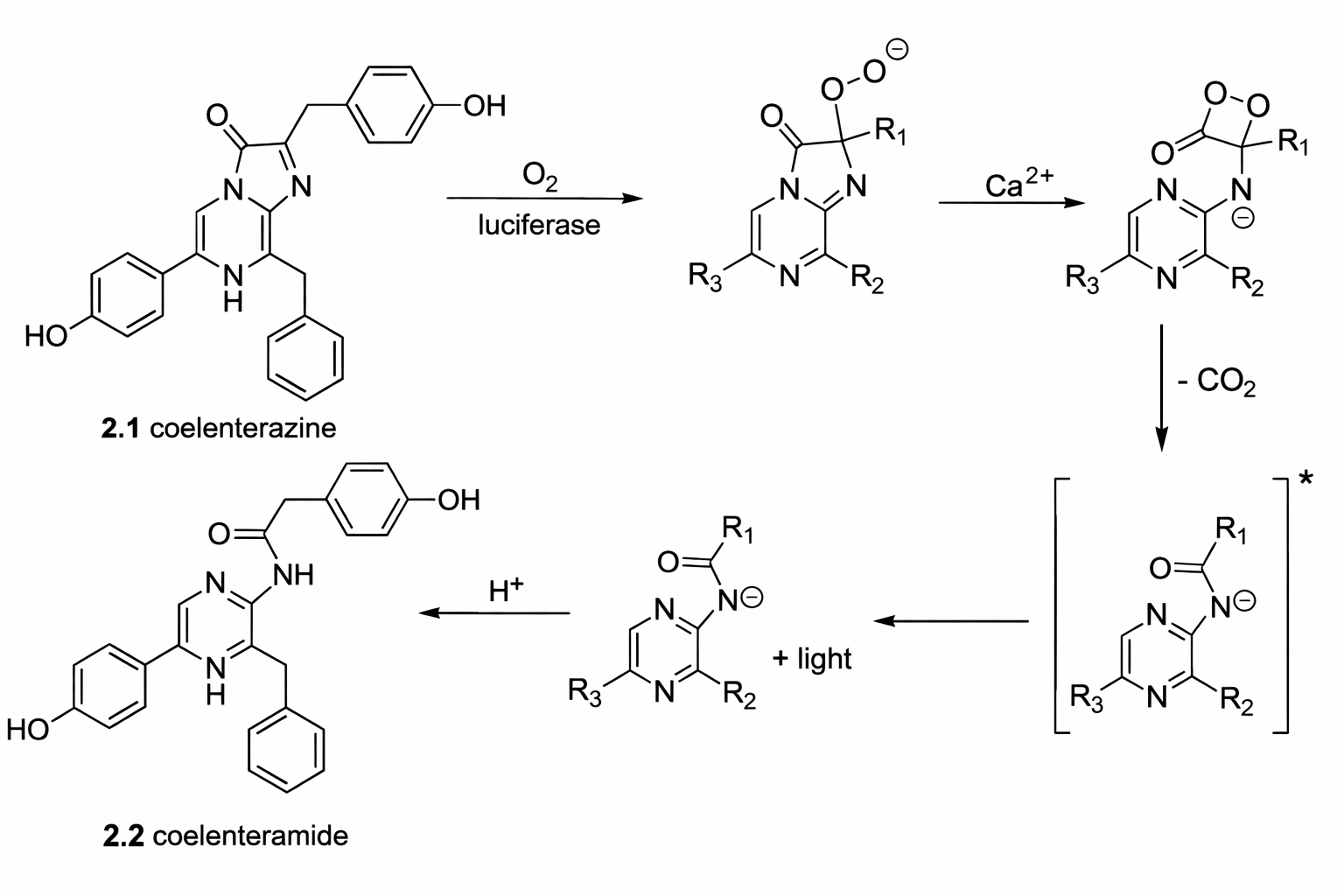
Under luciferase catalysis, CTZ reacts with O2 to form a peroxide intermediate and subsequently a high-energy four-membered ring intermediate; ring cleavage releases CO2 and yields an excited-state emitter. Photon emission occurs upon relaxation of the excited state to the ground state, producing measurable bioluminescence. This process typically does not require additional cofactors, which underlies the broad utility of CTZ-based systems.
2.2 Key variables governing signal quality
(1) Spontaneous oxidation and background control:
Background should be minimized by light protection, low-temperature handling, aliquoting, and reduced exposure time; prior to plate reading or imaging, verify stability of background levels in blank wells/negative samples.
(2) Solvent compatibility and matrix effects:
Stock-solution solvents must be compatible with cells or enzyme systems; dilution procedures should avoid local high concentrations that can inactivate proteins or induce cytotoxicity; within a batch, use a consistent solvent system and a fixed addition sequence.
(3) Kinetic matching and acquisition parameters:
Reaction rates and peak shapes vary substantially across analogs; integration time, sampling frequency, and detector gain should be matched accordingly to avoid saturation and apparent signal compression, with priority given to operating within the linear response range of the instrument.
III. Native Coelenterazine vs. Analogs: Key Metrics and Selection Logic
3.1 Core differentiating metrics
(1) Spectral properties:
Emission maxima determine channel bleed-through and filter configuration, particularly for BRET and multi-channel readouts.
(2) Luminescence intensity and signal-to-noise:
These govern feasibility in low-expression/weak-signal contexts and short acquisition windows, while also affecting saturation risk.
(3) Reaction kinetics and Ca2+ sensitivity:
These are critical for resolving transient responses and detecting small-amplitude Ca2+ changes in aequorin-based assays.
(4) Stability and cell permeability:
These determine intracellular loading efficiency, reproducibility in in vitro/in vivo settings, and baseline background levels.
3.2 Distinguishing features of representative analogs
(1) Native coelenterazine (CTZ, CAS 55779-48-1):
Broad compatibility and robustness; suitable as a reference substrate for aequorin reconstitution, reporter assays, and baseline BRET workflows, and can also support selected ROS/RNS-related chemiluminescence readouts.
(2) Coelenterazine 400a (CAS 70217-82-2):
Emission near ~400 nm; commonly used in GFP-acceptor BRET configurations to reduce acceptor-channel bleed-through; compatibility with specific luciferase constructs should be validated empirically.
(3) Coelenterazine H (CAS 50909-86-9):
A dehydroxylated analog of native CTZ; often used to achieve higher output and increased Ca2+ sensitivity, supporting detection of subtle Ca2+ fluctuations and improved sensitivity in weak-signal regimes.
(4) Coelenterazine hcp (CAS 123437-32-1):
Can yield very high luminescence and rapid Ca2+ response in aequorin-related systems, enabling low-expression assays or short integration times; substrate concentration and acquisition settings must be tightly controlled to prevent saturation.
(5) Coelenterazine cp:
In some systems, increases output while maintaining a fast rising phase, supporting higher-throughput readouts and time-resolved experimental designs.
(6) Coelenterazine f (CAS 123437-16-1):
Combines relatively strong luminescence with improved cell permeability, supporting intracellular loading while maintaining high Ca2+ sensitivity; often used for live-cell measurements and rapid kinetics acquisition.
(7) Coelenterazine n (analog class):
Generally weaker output and slower Ca2+ kinetics; can be used to reduce sensitivity to expand linear range, mitigate saturation in strong-signal settings, or serve as a kinetic-control substrate.
(8) Coelenterazine e (CAS 114496-02-5):
Rapid aequorin reconstitution in vitro and dual-emission features (e.g., ~405 nm and ~465 nm), enabling ratiometric strategies to improve Ca2+ quantification robustness; lower cell permeability and relatively limited solution stability make it better suited to in vitro systems or specialized quantification workflows.
3.3 Comparative spectral and kinetic parameters across coelenterazine substrates
The table below summarizes emission maxima (Em), RLC1, relative intensity, and half-rise time across representative substrates, supporting preliminary selection and parameter planning for BRET channel design, fast transient capture, and weak-signal amplification.
(1) Methodological meaning of Em (nm)
①Used to evaluate spectral matching between donor emission and acceptor absorption; it is the primary parameter for selecting acceptor fluorescent proteins, filters/spectrometers, and detection channels in BRET.
②Used to assess spectral separation and bleed-through risk; when Em substantially overlaps with acceptor channels, mitigation may require narrower bandwidth filters, alternative acceptors, or substrate substitution to reduce cross-talk.
(2) Comparative meaning of RLC1 and Relative Intensity
①RLC1 can be used to compare relative output or effective light-emission efficiency across substrates under a shared test framework, and is most informative when interpreted together with Relative Intensity to balance "strength–linearity–background".
②Relative Intensity reflects luminescence output under comparable conditions and directly determines detectability in weak-signal systems; when intensity increases substantially, lowering substrate concentration or shortening integration time can reduce auto-oxidation background and saturation risk.
(3) Kinetic meaning of Half-rise time (ms)
①Reports rising-edge speed and time resolution, which is critical for fast Ca2+ transients, rapid receptor activation/inactivation, and high-frequency kinetic sampling.
②When fitting rising-phase kinetic parameters (e.g., rise-rate constants or time-to-peak), shorter half-rise times can improve fit stability but require higher sampling rates and stricter synchronization of substrate addition.
(4) Scenario-based selection guidance
①BRET and multi-channel detection: prioritize Em for spectral matching and minimized bleed-through, then increase Relative Intensity within acceptable background constraints to maximize signal-to-noise.
②Aequorin-Ca2+ measurements: prioritize Half-rise time to match target Ca2+ kinetics, then use Relative Intensity to determine integration time and sampling frequency, while leveraging permeability and stability to reduce drift.
③High-throughput screening: select substrates with moderate-to-high intensity while maintaining linear range and batch-to-batch consistency; standardize substrate addition and fixed readout windows to reduce variance.
Product name | Em (nm) | RLC1 | Relative Intensity | Half-rise time (ms) |
Native coelenterazine | 466 | 1 | 1 | 6–30 |
Coelenterazine h | 466 | 0.75 | 16 | 6–30 |
Coelenterazine 400a | 400 |
|
|
|
Coelenterazine hcp | 445 | 0.65 | 500 | 2–5 |
Coelenterazine cp | 442 | 0.63 | 28 | 2–5 |
Coelenterazine f | 472 | 0.8 | 20 | 6–30 |
Coelenterazine n | 468 | 0.25 | 0.15 | 6–30 |
Coelenterazine e | 405 & 465 | 0.5 | 4 | 0.15–0.3 |
IV. Application Systems: Differentiated Needs and Methodological Considerations
4.1 Ca2+ sensing: the aequorin complex system
Aequorin emits light upon Ca2+ binding; CTZ, as its chromophore, determines output intensity, Ca2+ sensitivity, and kinetic response. Analog selection should be guided by the target Ca2+ range, transient duration, sampling frequency, and whether ratiometric quantification is used.
(1) Small-amplitude fluctuations and fast transients:
Prioritize high-sensitivity, fast-responding analogs and co-optimize acquisition frequency and integration time.
(2) Improving quantitative robustness:
In vitro systems may leverage dual-emission analogs for ratiometric readouts to reduce system variability.
4.2 Reporter-gene and protein-function assays: substrates for marine luciferases
CTZ-based systems are widely used for gene expression, promoter activity, protein–protein interactions, and protease cleavage assays. Key methodological priorities are background control and matching enzyme–substrate kinetics.
(1) Signal–background separation:
Include substrate-only blanks, negative controls, and positive controls; where appropriate, define standard curves and linear ranges.
(2) Assessment of matrix effects:
Secreted formats or complex sample matrices may alter substrate stability and background; evaluate matrix matching and dilution strategies.
4.3 BRET: energy-transfer measurements without external excitation
BRET depends on spectral matching between donor emission and acceptor absorption and is strongly influenced by bleed-through and filter configuration. Substrate selection should be optimized around donor emission maxima, acceptor-channel interference, decay kinetics, and the intended acquisition window.
(1) Reducing channel bleed-through:
In GFP-acceptor BRET, substrates with emission closer to ~400 nm can be prioritized to reduce interference.
(2) Matching the time window:
Differences in decay profiles and peak shapes require standardized acquisition timing and integration parameters to ensure comparability.
4.4 ROS/RNS-related measurements: oxidative-stress readouts
CTZ can be used for chemiluminescence-based detection of oxidative species in cells or tissues; however, specificity requirements are higher and should be supported by stringent controls and inhibitor/scavenger validation.
(1) Specificity confirmation:
Include scavenger/inhibitor controls to attribute signal origin and assess contributions of metal ions and light exposure to background.
(2) Inter-batch consistency:
Standardize aliquoting, freeze–thaw counts, and exposure times to reduce background drift and batch effects.
4.5 In vivo imaging and pharmacodynamic evaluation
In vivo performance depends not only on substrate chemistry but also on dosing route, biodistribution, and tissue optical properties. Standard operating procedures should define dose, imaging time points, and normalization strategies to reduce inter-individual variability and improve comparability.
V. Practical Use and Quality-Control Recommendations
5.1 Sample handling and storage
(1) Light-protected aliquoting:
Aliquot into small volumes to reduce freeze–thaw cycles and room-temperature exposure.
(2) Low temperature and dryness:
Store at −20°C under light protection and airtight conditions; minimize moisture uptake and light exposure during handling.
5.2 Solution preparation and control design
(1) Stock-solution strategy:
Prioritize high-concentration stocks in methanol/ethanol; dilute immediately before use and minimize residence time in aqueous media.
(2) Control structure:
At minimum include substrate-only blanks, negative controls, and positive controls; for ROS/RNS applications, include inhibitor/scavenger validation.
5.3 Instrument settings and data comparability
(1) Avoid saturation:
For high-output analogs, reduce substrate concentration, shorten integration time, or lower gain to remain within the linear range of the instrument.
(2) Standardize acquisition windows:
Keep sampling time points and integration parameters consistent within an experiment, and record the delay between substrate addition and acquisition to reduce kinetic bias.
VI. Aladdin-related products
6.1 Coelenterazine (CTZ)–Related Product List
Catalog No. | Product Name | CAS No. | Grade and Purity |
Coelenterazine | 55779-48-1 | ≥94% | |
Coelenterazine | 55779-48-1 | 10mM in DMSO | |
Coelenterazine hcp | 123437-32-1 | BioReagent, Ultra pure, ≥95%, solid | |
Coelenterazine 400 a | 70217-82-2 | ≥95% | |
Coelenterazine | 55779-48-1 | Suitable for molecular biology, ≥95%(TLC) | |
Coelenterazine e | 114496-02-5 | 0 | |
Coelenterazine fcp | 123437-33-2 | solid | |
Coelenterazine 400a | 70217-82-2 | Suitable for molecular biology, ≥95%(TLC) | |
Coelenterazine h hydrochloride | — | ≥98% | |
Coelenterazine h | 50909-86-9 | BioReagent, ≥98%(HPLC) |
6.2 Key Determinants of CTZ Bioluminescence and Specificity-Validation Control Reagents
Category | Reagent | CAS No. | Applicable Assays | Relationship to CTZ Signal | Key Notes |
Aequorin–Ca²⁺ triggering | Calcium chloride (CaCl2) | Aequorin–Ca²⁺ calibration curve; dynamic-range calibration | Ca²⁺ directly triggers Aequorin–CTZ bioluminescence, determining peak intensity and kinetics | Prepare fresh; avoid precipitation with phosphate; fix ionic strength | |
Aequorin–Ca²⁺ triggering | EGTA (ethylene glycol-bis(β-aminoethyl ether)-N,N,N',N'-tetraacetic acid) | Low-Ca background; free Ca²⁺ buffering system | Chelates Ca²⁺ to reduce CTZ-triggered emission probability, lowering background and defining buffer windows | Pair with CaCl2 to calculate free Ca²⁺; fix pH | |
Aequorin loading/permeabilization | Digitonin | Semi-permeabilization for Aequorin loading / control of intracellular ions | Controlled permeabilization affects Aequorin–CTZ loading and intracellular ionic conditions, altering CTZ emission amplitude | Narrow working window; determine threshold in pilot tests | |
Aequorin loading/permeabilization | Saponin | Permeabilization control (alternative to digitonin) | Similarly modulates Aequorin–CTZ loading efficiency and Ca²⁺ accessibility via permeabilization | Strong cell-type dependence; note batch effects | |
Ca²⁺ kinetics positive control | Ionomycin | Induce rapid Ca²⁺ elevation; verify CTZ emission upper bound | Rapidly elevates intracellular Ca²⁺ to trigger strong Aequorin–CTZ emission; positive control | Control dose to avoid irreversible damage; fix delay from addition to acquisition | |
Ca²⁺ store-release control | Thapsigargin | ER Ca²⁺ store-release model | Reshapes intracellular Ca²⁺ time course, thereby altering CTZ peak shape and decay | Strong stressor; optimize time window and include activity controls | |
Substrate auto-oxidation amplification | Copper sulfate (CuSO4) | Metal-catalyzed background-sensitivity testing | Cu²⁺ can catalyze CTZ oxidation, amplifying non-specific background emission for stress testing | Low concentrations can be impactful; must set blank wells | |
Substrate auto-oxidation amplification | Ferrous sulfate (FeSO4) | Fenton-related background-sensitivity testing | Fe²⁺ can promote oxidative chain reactions, increasing and drifting CTZ background | Fe²⁺ oxidizes readily; prepare fresh and control oxygen exposure | |
ROS triggering/validation | Hydrogen peroxide (H2O2) | ROS-associated CTZ chemiluminescence validation | Provides oxidative pressure to test CTZ chemiluminescence / background rise under ROS | Prepare fresh; decomposition causes dose drift | |
ROS source validation | Menadione | Cellular superoxide-generation model | Redox cycling elevates O2•− to test whether CTZ signal increases with O2•− | High cytotoxicity; run parallel viability/toxicity readouts | |
O2•− generation system | Xanthine | In vitro XO system to generate O2•− | Generates O2•− to test CTZ superoxide sensitivity | Requires XO; fix reaction time window | |
O2•− generation system | Xanthine oxidase (XO) | In vitro O2•− generation | With xanthine, provides a reproducible O2•− source for CTZ signal-origin validation | Record unit activity; avoid batch-to-batch variation | |
O2•− specificity control | Superoxide dismutase (SOD) | (XO system or cells) O2•− scavenging control | Removes O2•−; a decrease in CTZ signal supports a superoxide-driven contribution | Paired design (±SOD) with the generation system | |
H2O2 specificity control | Catalase | H2O2 scavenging control | Decomposes H2O2 to assess H2O2 contribution to CTZ signal | Paired design (±catalase) with H2O2 | |
RNS/NO source control | Sodium nitroprusside | NO donor control; RNS sensitivity validation | Provides NO-related stimulation to test whether CTZ signal is influenced by RNS | Photosensitive; fix delay from addition to acquisition | |
Substrate/wall-loss control | Bovine serum albumin (BSA) | In vitro reactions / plate assays to reduce adsorption | Reduces effective-concentration fluctuations and inter-batch drift caused by hydrophobic CTZ adsorption to vessel walls | Grade-dependent; include blanks | |
Optical path/crosstalk check | Luciferin | BRET-channel crosstalk and filter leakage check (auxiliary) | Not part of CTZ emission chemistry; used to verify detection-channel leakage that could create false signals | Optical validation only; measure separately from CTZ reactions |
CTZ systems are characterized by excitation-free operation, relatively low background, and high sensitivity, yet data quality is highly sensitive to substrate stability management and methodological standardization. Native CTZ is suitable as a robust, general-purpose choice for establishing baseline workflows; when higher demands are placed on spectral cross-talk, transient kinetics, intracellular loading, or quantitative robustness, analogs should be selected based on spectral profile, intensity, kinetics, stability, and permeability, followed by small-scale pilot experiments to fix substrate concentration, addition order, and acquisition parameters. With systematic optimization of substrate handling, control design, and instrument settings, CTZ substrates can deliver reproducible and interpretable results across Ca2+ sensing, reporter-gene assays, BRET studies, and oxidative-stress evaluations.